
What Is an Alternating Pressure Air Mattress? A Plain-English Guide
24 July 2026 · Nathan Kerrins
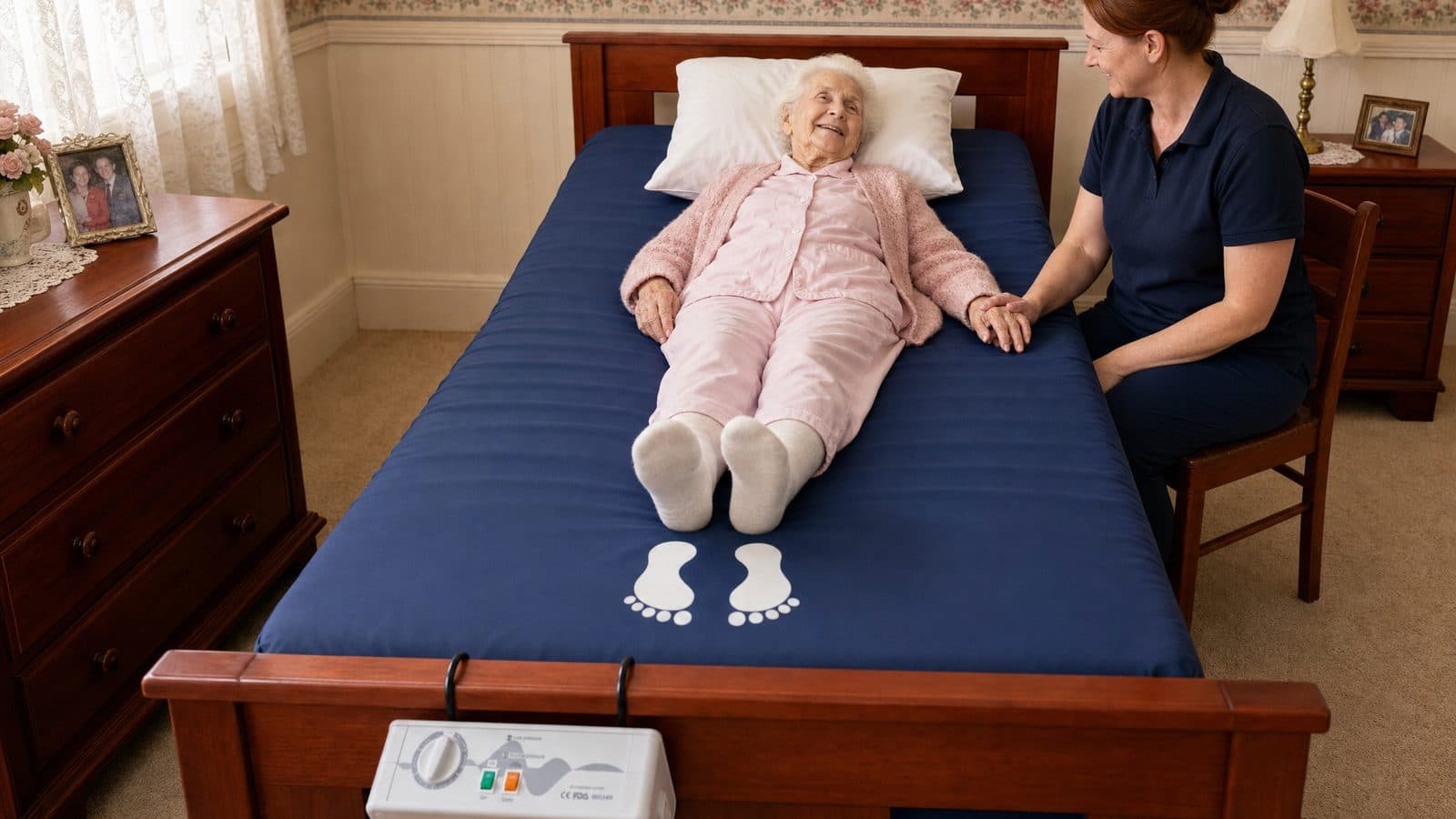
If a nurse, occupational therapist or discharge planner has mentioned an "alternating pressure mattress" — or you're caring for someone spending more and more of the day in bed — this guide explains what these systems actually are, in plain English: how they work, who they're for, and what they're like to live with.
One thing to say upfront: pressure care is a clinical topic. This article is general information, and an air mattress is one tool inside a care plan — it doesn't replace the repositioning, skin checks and advice your health professionals set for your situation.
Disclosure first: this is the Sleep Sophie site. We sell the Sophie alternating air mattress, so read this as a specialist supplier's explainer — the concepts hold whichever system your clinician recommends.
How an alternating pressure mattress works
Lie in one position long enough and the weight of your body squeezes the skin and tissue between bone and mattress — heels, hips, tailbone, shoulders. Healthy sleepers fidget and roll to relieve that automatically. People who can't reposition themselves easily don't get that protection, and sustained pressure on one spot is how skin damage starts.
An alternating pressure mattress tackles the problem mechanically:
- The mattress is built from rows of air cells connected to a quiet pump.
- The pump inflates and deflates alternate cells in slow cycles — one set carries your weight while its neighbours rest, then they swap.
- The effect is that no part of the body carries pressure for long, without the sleeper having to move at all — the mattress does the repositioning work that the body can't.
That's the entire trick, and it's why clinicians reach for these systems when someone spends extended time in bed.
Who alternating pressure systems are for
Typically, clinicians recommend them for:
- People spending long stretches in bed — through illness, surgery recovery, disability or age — who can't easily reposition themselves.
- People assessed as at risk of pressure injuries, or recovering from them, as part of a clinician-led pressure care plan.
- People managing swelling (oedema) or poor circulation, where the gentle, constant redistribution of load works alongside leg elevation — which is why these systems pair naturally with an adjustable bed that raises the legs.
- Carers looking after someone at home, where overnight repositioning is wearing everyone down. Our guide to pressure care at home for family carers covers that side in detail.
Whether you need one is exactly the question an OT or nurse answers — if you've been told "just get a firmer mattress" and something feels off, ask for a proper pressure-care assessment.
What it's actually like to sleep on
The honest answers to the questions everyone asks:
- Comfort: modern systems are designed for full-time sleeping, not just hospital stays. The cycling is slow and subtle — most people stop noticing it within a night or two.
- Noise: the pump runs at a low hum, quieter than a bedside fan, and sits at the foot of the bed.
- Feel: a breathable, waterproof cover sits over the cells, so it feels like a mattress rather than machinery — and the cover wipes down or machine-washes for easy hygiene.
- Settings: firmness and cycle timing adjust on the pump, so the system can be tuned to the person, not the other way around.
The Sophie alternating air mattress, specifically
Our system is an ARTG-registered medical device — listed on the Australian Register of Therapeutic Goods, the credential clinicians look for in pressure-care equipment. It comes in Long Single and King Single sizes, lays over most existing mattresses or bases (including Sophie adjustable beds), and is backed by a 5-year comprehensive warranty covering the pump, motor, controls and air cells. Delivery and setup are free, anywhere in Australia — our team installs it on your bed and demonstrates every function before we leave.
If you're comparing options first, our guide to alternating vs static air mattresses covers when the simpler (and cheaper) static approach is genuinely enough.
Funding: NDIS, Support at Home and private
Pressure-care systems are classic assistive technology. NDIS participants can pursue one through the AT funding pathway with an OT's recommendation; older Australians on Support at Home use the AT-HM equipment scheme. Sleep Sophie is a registered NDIS provider (4050070896) and we prepare the quotes and product documentation both schemes ask for. Self-funding? Interest-free payment options are available through Humm, Brighte and Payright — no-deposit options available to approved purchasers.
Frequently asked questions
Is an alternating air mattress comfortable for everyday sleep?
Yes — modern systems like Sophie's are designed for full-time sleeping. The movement is slow and subtle; most people stop noticing it within a night or two.
Is the pump noisy?
The pump runs at a low hum, quieter than a bedside fan. It sits at the foot of the bed and most users say they don't hear it at all once they're settled.
Do I need a prescription to buy one?
No prescription is needed to buy one. If you're using NDIS or aged-care funding, an occupational therapist's recommendation usually supports the claim — we can liaise with your OT directly.
Will it work on my existing bed?
Yes. The system lays over most existing mattresses or bases, including Sophie adjustable beds. We'll confirm fit for your bed when you enquire.
Questions about your situation? Call 1300 975 337 (1300 9 SLEEP) or send us an enquiry — and if a clinician is involved in your care, bring them into the conversation early. We're happy to talk directly with them.
Information on this page is general in nature and is not a replacement for professional medical advice. Talk to your GP, occupational therapist or treating clinician about what suits your situation.
Compare the Sophie range with a real person
No call centres, no scripts — tell us what you need and we’ll give you straight answers on fit, delivery and funding.
1300 975 337 (1300 9 SLEEP) · Australian-based team · Explore the Sophie alternating air mattresses
Rated 4.8 from 227 reviews on ProductReview.com.au · Free in-home demonstration · Interest-free options via Humm, Brighte & Payright for approved purchasers
Using NDIS or Support at Home funding?
Sleep Sophie is a registered NDIS provider (4050070896), and Sophie adjustable beds and lift recliners are ARTG-registered Class 1 medical devices (ARTG 326115). Beds can be funded through NDIS assistive-technology budgets where an occupational therapist recommends them; the Support at Home program has its own equipment pathway. We prepare quotes suitable for plan approval — see how NDIS funding works or Support at Home, or call and we’ll walk you through it.
Ask us about this bed
Free delivery and installation, Australia-wide — tell us what you’re after and we’ll get back to you with straight answers.