
Carers: Reducing Back Strain in Everyday Care
24 October 2026 · Nathan Kerrins
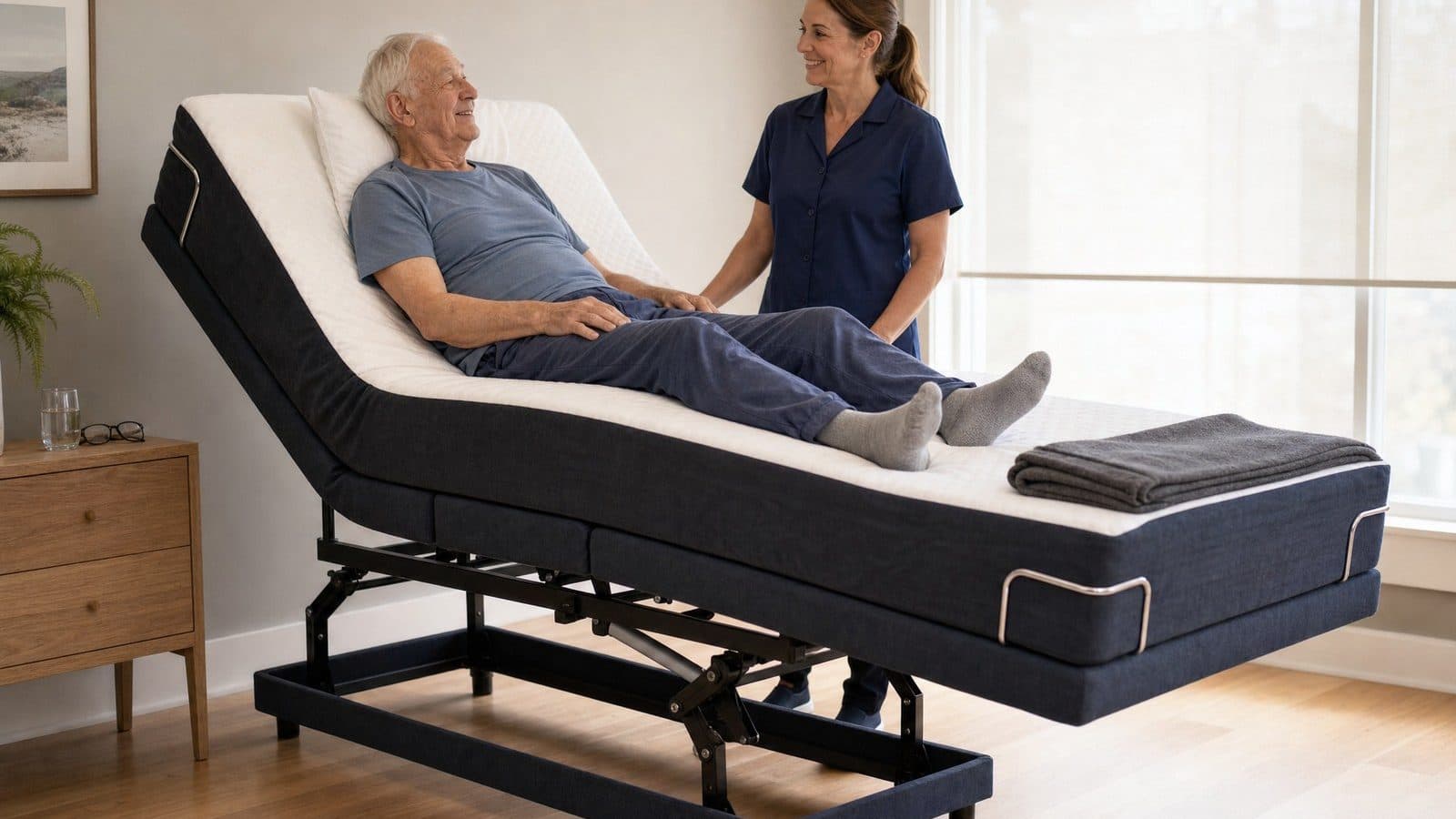
Bending and lifting at a bed's normal height is a common source of carer back strain, since most beds suit sleeping, not standing care tasks. Safe Work Australia's manual-handling guidance recommends adjusting the work height and reducing awkward postures. A height-adjustable bed applies that principle at home.
If you're caring for someone at home, you already know the physical toll rarely gets talked about. Everyone asks how the person you're caring for is doing; almost nobody asks about your back. This guide sets that straight, using the same manual-handling thinking that governs how workplaces are meant to protect people who lift and bend for a living, and looking at how it applies to a bedroom rather than a warehouse.
Disclosure: this is the Sleep Sophie site, and we sell the Sophie HiLo adjustable bed. That's relevant here because whole-bed height adjustment is one of the few pieces of home equipment built specifically around this problem — so read what follows with that in mind.
Why do carers get back strain from everyday bed tasks?
A standard bed is built for one job: being comfortable to sleep in. That means it sits low — low enough to climb into easily, nowhere near a comfortable standing height for someone working beside it. Every task done at that bed inherits the same problem: dressing, washing, repositioning, changing sheets, adjusting pillows, helping someone sit up. None of these is a heavy lift on its own. The strain comes from doing dozens of small bent-over movements a day, day after day, for months or years.
That pattern — light load, poor posture, high repetition — is exactly the combination workplace safety regulators warn about. It's also easy to dismiss, because no single moment feels dangerous. Carers tend to notice the damage only once it's already a standing ache or a bad twinge, by which point the habit is well established.
What does official manual-handling guidance actually recommend?
You don't need to guess at this — it's covered by Safe Work Australia's Model Code of Practice: Hazardous Manual Tasks. It's written for workplaces, but the underlying principles apply wherever someone is repeatedly bending, twisting or lifting, including at home. The guidance points to a few consistent themes:
- Adjust the height of the task where possible, rather than asking the person to bend further to reach it.
- Minimise bending and twisting, especially bending combined with a twist, which the guidance identifies as a particularly risky combination.
- Reduce the physical effort a task takes by using aids and equipment instead of relying on technique alone.
- Look at tasks that are repeated often, even if each one is individually light — repetition is treated as a risk factor in its own right.
None of this is about a single dramatic lift. It's about the accumulated cost of doing an awkward movement many times over, which is precisely the shape of most caring tasks at home.
How can adjusting bed height put that guidance into practice?
The most direct way to apply "adjust the task height" to a bed is, unsurprisingly, to adjust the bed's height. A hi-lo adjustable bed raises and lowers the whole platform electrically, rather than just tilting the head and foot sections. Raised to something closer to your own standing height, dressing, washing, repositioning and linen changes can be done without leaning as far over — which can make it easier to keep a better working posture through the task, rather than folding forward from the waist each time.
Lowered again afterwards, the same bed brings the person you're caring for down to a comfortable height for getting in and out, or for a seated transfer. Nothing here is presented as a fix for an existing back problem or a guarantee against injury — it's a practical way of putting "adjust the work height" into practice in a bedroom instead of a warehouse. The hi-lo range built with carers in mind covers the rest of what the bed offers beyond height, including powered positioning for the person lying in it. A standard electric adjustable bed tilts the head and foot sections only; the hi-lo adds whole-bed height.
On the Sophie HiLo specifically, that height adjustment is controlled from the same simple wireless remote as the head and foot positioning, with battery backup so it still moves through a power outage — worth knowing if someone in the household can't be repositioned manually without help.
What other habits reduce strain during care tasks?
Equipment is one part of the picture; habits matter too, and Safe Work Australia's guidance and Australia's Carer Gateway both point in a similar direction:
- Face the task, don't twist into it. Turning your feet and hips towards the bed instead of twisting your spine avoids the bending-plus-twisting combination the guidance flags as higher risk.
- Split heavier or awkward tasks where you can. Two shorter repositioning movements, or a second pair of hands for a harder transfer, both reduce load on any one lift.
- Use aids designed for the job — slide sheets for repositioning, or a properly fitted bed rail where an occupational therapist has recommended one — instead of relying on grip strength and a bent back.
- Look after your own wellbeing, not just the roster. Carer Gateway is explicit that a carer's physical and mental health is part of a caring arrangement working long-term, not an optional extra.
- Get a second opinion on technique, not just equipment. The same repositioning task can be done well or badly depending on foot position, grip and timing — a physiotherapist or an OT can watch you do it once and flag habits you can't see yourself.
None of these habits removes the need for the task itself. They shift where the load falls — onto legs and equipment, spread across two people, or onto a technique that's actually been checked — rather than concentrating it all on one bent spine, task after task.
When should you see a doctor or physio about back pain?
If back pain has already shown up — a persistent ache, stiffness that doesn't settle overnight, or a sharp twinge during a lift — that's a reason to see your GP or a physiotherapist, not to push through and hope it resolves on its own. This page is about reducing awkward postures before they become a problem; it isn't a treatment for pain that's already there, and nothing in it is a substitute for a proper assessment of your own back.
A physiotherapist can also assess your particular lifting and repositioning technique in a way a general guide never can, and an occupational therapy assessment can look at the household's whole setup, not just the bed. If the person you care for is coming home after an operation, our guide to adjustable beds after surgery covers each stage.
Can carer back strain factor into equipment funding?
It can be part of the picture you describe to the occupational therapist. The NDIS's guide to assistive technology says funding decisions rest on evidence, and an OT's report on how the bed will be used day to day — including by the person helping — is part of that evidence. It's worth saying plainly rather than underplaying it. See our guide on how the NDIS can fund an adjustable bed for how that pathway works, and how long a bed like this typically stays useful after surgery if recovery timeframes are part of your decision too.
For older Australians outside the NDIS, Support at Home's Assistive Technology and Home Modifications (AT-HM) scheme is a separate route. It starts with an aged care assessment through My Aged Care, and some equipment needs a prescription from a health professional.
Sleep Sophie is a registered NDIS provider (provider number 4050070896), and offers a free in-home demonstration — our team brings the HiLo to your home, sets it up, and lets you and the person you're caring for try the height adjustment and positioning for 30–60 minutes before anything is decided. It's a practical way to see whether the height range actually suits how your household works, obligation-free.
Key facts, sourced
| Fact | Source |
|---|---|
| Adjust the task or work height, and minimise bending and twisting, for repeated manual tasks | Safe Work Australia, Model Code of Practice: Hazardous Manual Tasks |
| A carer's own physical and mental wellbeing is part of a sustainable caring arrangement | Carer Gateway (Australian Government) |
| NDIS assistive technology funding rests on evidence, such as an assistive technology advisor's recommendation | NDIS — Guide to assistive technology |
| Sophie HiLo: whole-bed height adjustment, 250kg weight rating, Long Single and King Single sizes only | Sleep Sophie product specifications |
| Sleep Sophie is a registered NDIS provider | Provider number 4050070896 |
| Sophie HiLo: 5-year comprehensive warranty, standard | Sleep Sophie warranty terms |
None of this replaces a proper assessment of your own posture, your own back, or your own household's caring load — it's a starting point for the conversation, not the end of it.
This information is general in nature and not a replacement for professional medical advice. Talk to your GP, physiotherapist or occupational therapist about your situation.
Sleep better, every night
If being able to change position would help, see how the Sophie adjustable range works — or just call for a chat.
1300 975 337 (1300 9 SLEEP) · Australian-based team · Explore the Sophie HiLo adjustable beds
Rated 4.8 from 227 reviews on ProductReview.com.au · Free in-home demonstration · Interest-free options via Humm, Brighte & Payright for approved purchasers
Using NDIS or Support at Home funding?
Sleep Sophie is a registered NDIS provider (4050070896), and Sophie adjustable beds and lift recliners are ARTG-registered Class 1 medical devices (ARTG 326115). Beds can be funded through NDIS assistive-technology budgets where an occupational therapist recommends them; the Support at Home program has its own equipment pathway. We prepare quotes suitable for plan approval — see how NDIS funding works or Support at Home, or call and we’ll walk you through it.
Ask us about this bed
Free delivery and installation, Australia-wide — tell us what you’re after and we’ll get back to you with straight answers.