
Alternating vs Static Air Mattresses: Which Pressure-Care Approach Fits?
24 July 2026 · Nathan Kerrins
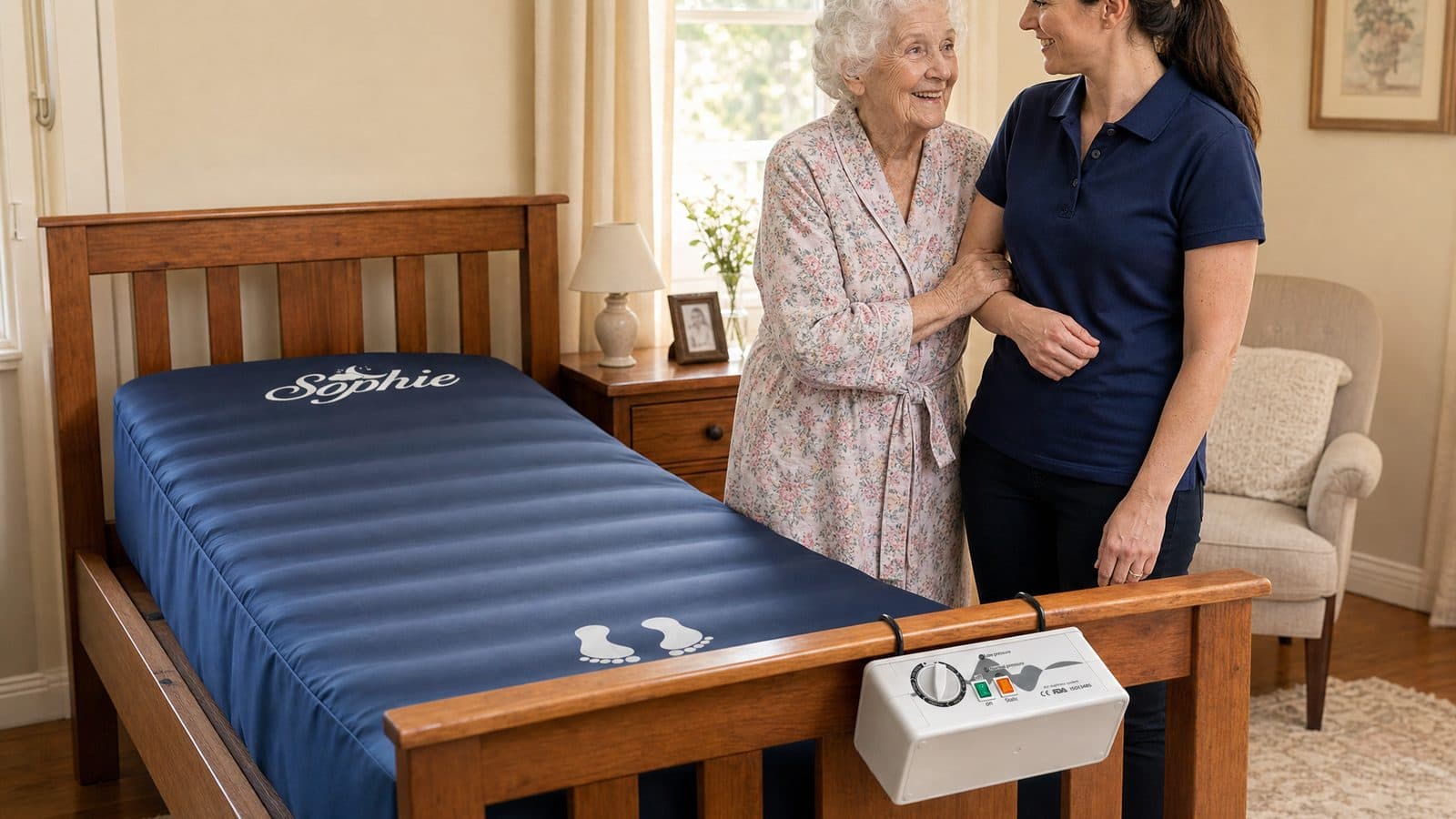
Shop for pressure-care equipment and you'll quickly meet two families of product with confusingly similar names: static surfaces and alternating systems. Both exist to protect skin from sustained pressure. They go about it in fundamentally different ways — and they suit genuinely different levels of need.
This is general information to help you have a better conversation with your health professional — pressure-care decisions belong with the OT or nurse who has actually assessed the person sleeping on the mattress.
Disclosure first: this is the Sleep Sophie site, and we sell one of the two categories — the Sophie alternating air mattress. We'll be straight about when the other category is the right answer.
Two different answers to the same problem
The problem is always the same: sustained pressure between bone and mattress restricts blood flow to skin and tissue, and people who can't reposition themselves don't get the natural relief that healthy sleepers give themselves by rolling over. The two approaches:
- Static surfaces spread the load. High-specification foam, gel overlays and non-powered ("static") air overlays work by immersion — letting the body sink in so weight spreads across more surface area, lowering the peak pressure at any one point. Nothing moves; the surface is simply better at sharing the load than a standard mattress.
- Alternating systems move the load. Powered air cells inflate and deflate in slow cycles, so each area of the body alternates between carrying weight and resting. Instead of lowering the pressure everywhere a little, the system removes it from each spot regularly — mechanical repositioning, all night long. We've explained the mechanics fully in what is an alternating pressure air mattress.
The side-by-side comparison
| Static (foam / gel / static air) | Alternating (powered air cells) | |
|---|---|---|
| How it protects | Spreads pressure passively by immersion | Actively cycles pressure off each area in turn |
| Power required | No | Yes — quiet bedside pump |
| Typically suits | Lower assessed risk; people who still reposition reasonably well | Higher assessed risk, limited self-repositioning, extended time in bed |
| Moving parts | None | Pump and cells — which is why warranty coverage matters |
| Cost | Generally lower | Higher — it's a powered medical device |
| Feel | Still; conforming | Slow, subtle movement most people tune out within a night or two |
When static is genuinely enough
Honestly: often. If the person still moves in bed, spends most of the day out of it, and a clinician rates the pressure risk as lower, a quality supportive surface plus a sensible repositioning routine may be all that's needed. Good foam does real pressure-redistribution work — it's one of the jobs the four-layer design of the Sophie bed mattress is built around, with pressure redistribution engineered into its Hygroflex® top layer. In those situations we'd rather you spend your money on the right bed than add a powered system you don't need.
When clinicians reach for alternating
The picture changes when someone can't reposition themselves reliably, spends extended time in bed, has fragile skin or a history of pressure damage, or is coming home from hospital with a pressure-care plan. That's the territory where health professionals usually specify an alternating system — the active cycling does the repositioning work the person can't, hour after hour, without a carer having to wake and turn them as often through the night.
If that sounds like your household, two related reads: our pressure care guide for family carers, and — because positioning and pressure care usually travel together — what a hi-lo adjustable bed is.
Where the Sophie system sits
The Sophie alternating air mattress is an ARTG-registered medical device with adjustable firmness and cycle settings, a breathable waterproof cover, and a 5-year comprehensive warranty across pump, motor, controls and cells. It lays over most existing mattresses and bases — including Sophie adjustable beds — and is delivered and set up free, anywhere in Australia. Funding-wise it's classic assistive technology: NDIS with an OT recommendation, or the Support at Home AT-HM scheme for older Australians, and Sleep Sophie is a registered NDIS provider (4050070896).
Frequently asked questions
Is an alternating air mattress better than a static one?
Neither is universally better — they solve different levels of need. Static surfaces spread pressure passively and suit people at lower risk who still reposition reasonably well. Alternating systems actively cycle the load and are what clinicians usually specify for people at higher risk or spending extended time in bed.
Who decides which type I need?
Ideally a health professional — an occupational therapist or nurse doing a pressure-care assessment. Risk level, mobility, skin history and time spent in bed all feed the decision. If you haven't been assessed and pressure is a genuine worry, ask for one before buying anything.
Can I put an alternating air mattress on an adjustable bed?
Yes — the Sophie system works on most existing mattresses and bases, including Sophie adjustable beds, so positioning and pressure care can work together.
Why does Sleep Sophie only sell the alternating type?
Because that's where a specialist system earns its price. Simple static overlays are widely available and often all that's needed at lower risk — we'll tell you so. When needs are higher, we believe an ARTG-registered alternating system is the right tool, and that's the one we've chosen to stand behind with a 5-year warranty.
Still weighing it up? Call 1300 975 337 (1300 9 SLEEP) or send us an enquiry — describe the situation and we'll tell you honestly which category it sounds like, and whether to get an assessment first.
Compare the Sophie range with a real person
No call centres, no scripts — tell us what you need and we’ll give you straight answers on fit, delivery and funding.
1300 975 337 (1300 9 SLEEP) · Australian-based team · Explore the Sophie alternating air mattresses
Rated 4.8 from 227 reviews on ProductReview.com.au · Free in-home demonstration · Interest-free options via Humm, Brighte & Payright for approved purchasers
Using NDIS or Support at Home funding?
Sleep Sophie is a registered NDIS provider (4050070896), and Sophie adjustable beds and lift recliners are ARTG-registered Class 1 medical devices (ARTG 326115). Beds can be funded through NDIS assistive-technology budgets where an occupational therapist recommends them; the Support at Home program has its own equipment pathway. We prepare quotes suitable for plan approval — see how NDIS funding works or Support at Home, or call and we’ll walk you through it.
Ask us about this bed
Free delivery and installation, Australia-wide — tell us what you’re after and we’ll get back to you with straight answers.