
Full-Electric vs Semi-Electric Beds: The Difference
10 October 2026 · Nathan Kerrins
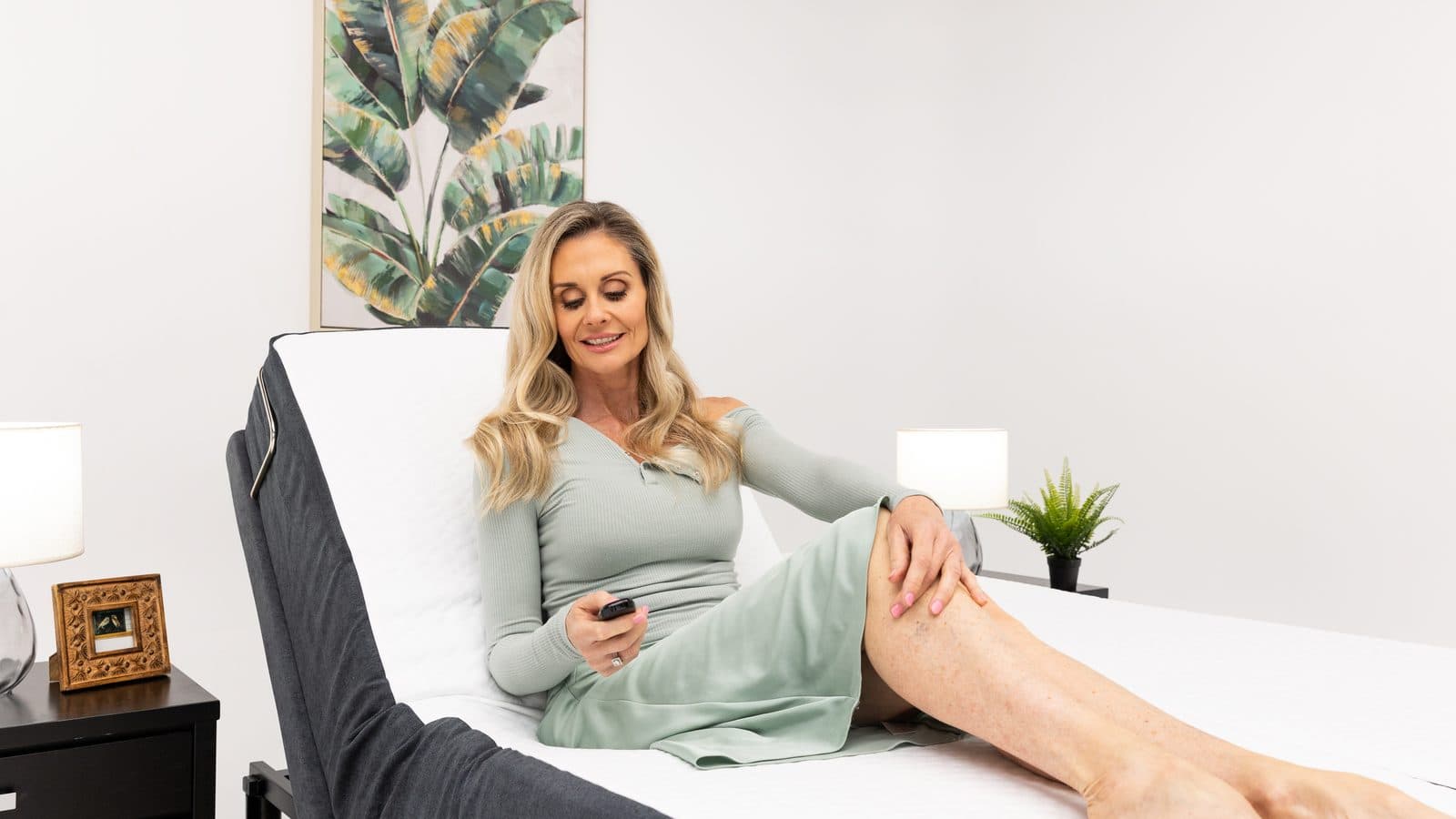
A full-electric bed motorises every position it offers, controlled entirely by remote. A semi-electric bed motorises some positions — usually head and foot — but leaves at least one adjustment, commonly height, to a manual crank. The trade-off is independence and convenience (full-electric) versus a lower cost with more manual effort (semi-electric).
Both terms come from the hospital and home-care bed world, which is why they can sound clinical even when you're simply comparing options for a bedroom at home. If you've been reading spec sheets for adjustable beds and keep tripping over "full-electric" and "semi-electric" without a plain explanation of what each one actually changes for the person using the bed, this is that explanation.
What's the difference between full-electric and semi-electric?
The short version: full-electric means a motor handles every adjustment the bed offers, and the occupant (or a carer) drives all of it from a handset. Semi-electric means some of those adjustments are motorised and at least one still needs a manual crank, turned by hand at the frame. Generic hospital-bed and home-care industry guides define the categories the same way — full-electric beds motorise head, foot and height via remote, while semi-electric beds motorise head and foot but rely on a manual crank for height, which is typically awkward for the occupant to reach themselves.
Neither term says anything about comfort, mattress quality or how the bed looks in a bedroom — it's purely about how many of the bed's movements are under motor control.
What does "full-electric" actually motorise?
On a genuinely full-electric bed, there's no crank anywhere. Every position change — raising the head, raising the feet, adjusting height where that's offered — happens at the press of a button on a wireless remote. That matters most for anyone who wants to reposition themselves through the day or night without waiting for someone else to be available to operate a manual mechanism. Full-electric control lets the occupant reposition independently, at 2am or whenever suits them, rather than depending on a carer to turn a crank.
On the Sophie range, head and foot positioning is fully motorised by wireless remote on every adjustable bed we sell. Whole-bed height, however, is a separate matter: on the standard range it's fixed at installation, set once to a height between 47.5cm and 65cm and then left as-is, rather than motorised or manually cranked. So "full-electric" for a Sophie bed describes how the head and foot move — not whether the whole bed height can be changed afterwards. We'll come back to where height adjustment actually sits in the next section, because it's a genuinely separate feature, not a semi-electric compromise.
What does a semi-electric bed still leave to a manual crank?
A semi-electric bed motorises head and foot movement — so far, the experience is similar to full-electric — but height adjustment is done by turning a crank, usually located at the foot of the frame. That crank has to be operated from outside the bed, by hand, which is one reason semi-electric beds are more commonly found in settings where a carer or family member is expected to make height changes occasionally, rather than the occupant adjusting things themselves through the day.
It's a genuine trade-off rather than a lesser option: semi-electric beds are generally more affordable than full-electric equivalents, because they carry fewer motorised components. For some households, that's the right call — particularly where height rarely needs to change, or where a carer is already on hand for other reasons.
Why would someone choose semi-electric anyway?
Cost is the most common reason, and it's a legitimate one. Fewer motors generally means a lower price, and if whole-bed height isn't something you expect to adjust often — or a carer is comfortable handling it when it does need to change — a semi-electric bed can do the job without paying for motorisation you won't use.
The trade-off shows up in independence. If you're the person in the bed and you want to change the height yourself without calling for help, a manual crank makes that difficult in practice — it typically sits at the foot of the bed and isn't designed to be reached comfortably from a lying position. That's a reasonable limitation to accept if height rarely changes; it's a real inconvenience if it changes often.
Where does whole-bed height adjustment fit into this?
This is where the three related ideas in adjustable beds are easiest to blur together, so it's worth being precise. Electric versus manual is about whether a motor or a hand crank drives a given movement at all. Full-electric versus semi-electric is about how many of a bed's movements are motorised. Whole-bed height adjustment is a separate feature again — how (or whether) the entire bed frame can be raised or lowered, which matters most for carer transfers and getting in and out safely.
On Sophie beds, that whole-bed height feature is powered on the HiLo specifically — it's the model built for households where the whole frame regularly needs to go up for care tasks and down for the occupant to get in and out safely. On the standard range, height is fixed at installation instead of adjustable at all, motorised or manual. So a standard Sophie bed isn't "semi-electric" in the traditional sense — it simply doesn't offer height adjustment as a feature, powered or cranked. If height adjustment is something your situation genuinely needs, that's a HiLo conversation, not a full- versus semi-electric one.
Which is right for your situation?
Start with who needs to operate the bed and how often. If you want to change your own position — head, feet, or eventually whole-bed height — independently and at any hour, full-electric control removes the barrier of needing someone else present. If a carer or family member is already involved in daily routines and height rarely needs to move, the manual crank on a semi-electric bed is less of a burden than it sounds, and the lower price can make sense.
Budget also plays a real part, and it's worth knowing the shape of the market rather than guessing. As general Australian market context across all brands, single adjustable beds typically run from around $3,000 to $13,000, and queen or king models from around $5,000 to $24,000, depending on features and motorisation. Where you land in that range often tracks how many motors the bed has and what else is built in.
Every Sophie adjustable bed uses Okin motors — one of the most recognised names in the adjustable bed industry — for head and foot positioning, controlled by wireless remote. If independent control matters to you, that's worth checking on any bed you're comparing, not just ours: ask specifically which movements are motorised and which need a crank, because "electric adjustable bed" alone doesn't tell you. Sophie's finance options — interest-free payment plans through Humm, Brighte and Payright, with no-deposit options available to approved purchasers — can also make a fully motorised bed more achievable up front; you can see current pricing and finance details on our electric adjustable beds page.
Rapid-fire: the terms side by side
| Question | Full-electric | Semi-electric |
|---|---|---|
| What moves by motor? | Every position the bed offers, via remote | Head and foot only |
| What's left to a manual crank? | Nothing | Usually height, at the foot of the frame |
| Who can operate it unassisted? | The occupant, independently, any time (Accessibility Medical Equipment) | Head/foot yes; height usually needs a carer or helper |
| Typical cost comparison | Higher, for the extra motorisation | Generally lower, with fewer motorised parts (Universal Med Supply) |
| Category definitions | Harmony Home Medical Supply, "Manual vs Semi-Electric vs Fully Electric Hospital Beds" | |
| On the Sophie range | Head/foot fully motorised on every bed; whole-bed height fixed at installation on the standard range, powered only on the HiLo | |
Still sorting out the terminology?
These categories get easier once you've seen them side by side against the related decisions. If you're still weighing motor versus crank as a first step, our guide to electric vs manual adjustable beds covers that distinction from the ground up. If you're not sure a fully motorised bed is necessary for your situation at all, do you need a full-electric adjustable bed? walks through how to decide. And if whole-bed height for carer transfers is the real question underneath all of this, that's covered properly on its own terms in our hi-lo bed guide, alongside our broader practical buying guide to every feature worth comparing.
Funding is sometimes part of this decision too. If your situation involves an NDIS plan or a recovery period, it's worth checking what a plan can and can't cover before you commit to a particular level of motorisation — our guides on whether the NDIS can fund an adjustable bed and whether Medicare covers adjustable beds in Australia are useful starting points on the funding side generally.
If you'd rather see the difference in person than read about it, our team can bring an electric Sophie bed to your home, set it up and demonstrate the remote control properly — no cost, no obligation. Book a free in-home demonstration and feel the difference between motor and crank for yourself.
Not sure it will fit?
We deliver and install free, Australia-wide — and we’ll tell you straight if it won’t work in your room.
1300 975 337 (1300 9 SLEEP) · Australian-based team · Explore the Sophie adjustable bed range
Rated 4.8 from 227 reviews on ProductReview.com.au · Free in-home demonstration · Interest-free options via Humm, Brighte & Payright for approved purchasers
Using NDIS or Support at Home funding?
Sleep Sophie is a registered NDIS provider (4050070896), and Sophie adjustable beds and lift recliners are ARTG-registered Class 1 medical devices (ARTG 326115). Beds can be funded through NDIS assistive-technology budgets where an occupational therapist recommends them; the Support at Home program has its own equipment pathway. We prepare quotes suitable for plan approval — see how NDIS funding works or Support at Home, or call and we’ll walk you through it.
Ask us about this bed
Free delivery and installation, Australia-wide — tell us what you’re after and we’ll get back to you with straight answers.