
Adjustable Bed vs Traditional Bed Frame
10 October 2026 · Nathan Kerrins
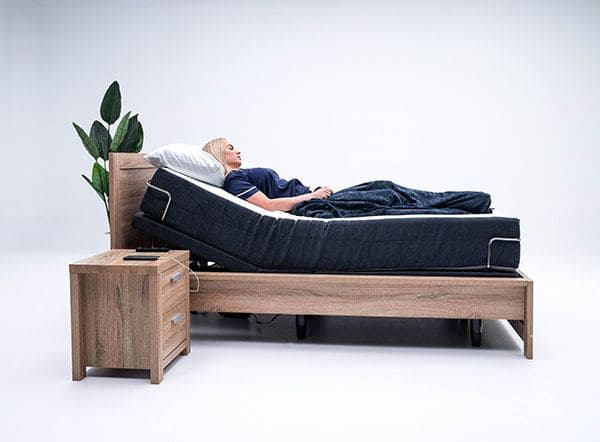
A traditional bed frame is a static platform — any mattress sits on top, and the whole bed stays flat. An adjustable bed's base moves the head and foot sections electrically and needs a mattress designed to flex with it. You can't simply move a traditional inner-spring mattress across — even a single bend can permanently damage its internal springs.
That's the short version. If you're standing in a bedroom right now trying to decide whether to keep the frame you've got or switch to a moving base, the honest answer depends on what you actually want from the bed — and on being clear-eyed about what does and doesn't change. Here's the comparison, cost category, positions, mattress, looks and all, including where a traditional frame is still the right call.
What's the difference between an adjustable bed and a traditional bed frame?
A traditional bed frame's only job is to hold a mattress off the floor. It has no moving parts, no motor and no electronics — it's a base, a headboard bracket point, and sometimes a footboard. Whatever mattress you put on it lies flat, always.
An adjustable bed base does that same job, plus one more: a motor inside the base raises and lowers the head and foot sections independently, controlled by a wireless remote with one-touch presets, including Zero Gravity. That movement is the entire point of the product — and it's also the reason the mattress has to be chosen differently. Here's how the two stack up at a glance.
| Traditional bed frame | Adjustable bed base | |
|---|---|---|
| Positions | Flat only — no moving parts | Independent head and foot sections, wireless remote, one-touch presets including Zero Gravity |
| Mattress compatibility | Any mattress, including traditional inner-spring | Needs a mattress built to flex with the base — not a swappable inner-spring |
| Sizes | Standard Australian sizes, Long Single to King | The same standard sizes, plus split options (Split Queen, Split King, Split Cali King) |
| Bedding | Standard doonas, blankets, pillows | Same doonas, blankets and pillows — only the fitted sheet needs to match the mattress size |
| Cost category | Generally the lower-cost option up-front | Higher up-front cost; a market range and finance options apply — see below |
| Weight rating | Varies by frame — check the specific model | 320kg per bed on the standard Sophie base |
Can I put my current mattress on an adjustable base?
This is the question that trips people up, and it's worth being direct about it: no, not if it's a traditional inner-spring mattress. Even a single bend can permanently damage the internal springs and wires inside an inner-spring mattress — it's built and engineered to lie flat, and it won't return to shape once it's been flexed at the hinge points where an adjustable base bends.
An adjustable base and its mattress need to be designed as one system. Sophie adjustable beds include a four-layer Australian-made mattress purpose-built for the moving base, topped with the RMIT-tested Hygroflex® comfort layer — it's not something you swap in from a mattress that was bought for a flat frame, and it's not something you can swap back out onto one either, for the same reason in reverse. If you want the detail on which mattress types genuinely work and which don't, our guide on whether you can use any mattress on an adjustable bed walks through it properly.
Does an adjustable bed take up more room than a traditional frame?
No — this is one of the more persistent misconceptions, and it isn't true. Adjustable beds are built in the same standard Australian sizes as a traditional frame, from Long Single through to Split Cali King, and the base occupies the same overall footprint as the frame it's replacing. What changes is what happens inside the frame, not how much floor space the bed claims in the room.
Where fit questions actually arise is around existing furniture — a bedhead you already own, or a frame you were hoping to keep and simply drop a new base into. That's a separate, more specific question from floor space, and it deserves its own answer: see our practical guide on whether adjustable beds fit in bed frames for the measurements that matter before you commit to keeping what you've got.
Do I need new bedding or a new bedroom suite?
No. Standard doonas, blankets and pillows all work exactly as they do on a traditional frame — nothing about the moving base changes how bedding sits on top once the bed is flat, which is most of the time. The only item that needs to match is the fitted sheet, and only because it has to match the mattress size, the same rule that applies to any bed.
You don't need to replace the bedroom suite either. Adjustable beds are built as bedroom furniture in their own right, with fabrics and finishes chosen for a bedroom rather than a ward, so switching from a traditional frame doesn't mean redesigning the room around a clinical-looking base.
What do you gain by switching from a traditional frame?
The gain is entirely in what the base can do once it's in the room. A traditional frame gives you one position: flat. An adjustable base gives you independent head and foot movement, controlled from a wireless remote, with one-touch presets including Zero Gravity — a position that can help some people feel more comfortable settling in for reading, screen time or drifting off. None of that is available from a frame with no moving parts, regardless of how good the mattress on top of it is.
It's worth being plain that this benefit sits in comfort and positioning, not in treatment — an adjustable bed can help some people feel more comfortable, but it isn't a treatment for any condition, and it's not a replacement for professional medical advice. If a specific health concern is part of your decision, talk it through with your GP, physiotherapist or occupational therapist alongside whatever you read here.
Is a traditional frame ever the better choice?
Yes, genuinely. For some households, a traditional frame with any compatible mattress remains the simpler, cheaper option, and there's no reason to switch away from something that's already working. If nobody in the bed needs powered positioning, and budget is the deciding factor, a traditional frame keeps things straightforward — no motor, no remote, no mattress restrictions, and generally the lower-cost category of the two.
Where the calculation shifts is when someone specifically wants the positioning — for reading in bed, easing into sleep, or simply not lying flat all night — and the trade-off in cost and mattress choice is one they're comfortable making. That's a genuinely personal call, and either answer is a reasonable one depending on what the bed needs to do for the people sleeping in it.
What does the cost actually look like?
Traditional frames span a wide price range depending on materials and brand, but they don't carry a mattress restriction, so the total spend is whatever frame plus whatever mattress you choose. Adjustable beds sit in a different market band — Australian market pricing for adjustable beds generally runs from the low thousands into the tens of thousands depending on size and features. A Sophie adjustable bed includes its four-layer Australian-made mattress, so when comparing quotes, check whether a mattress is included.
Sleep Sophie offers interest-free payment options through Humm, Brighte and Payright, with no-deposit options available to approved purchasers and a choice of repayment terms — see the current range and finance details rather than a figure quoted here, since pricing is always kept current on the product page rather than in a blog post. If cost is the main hurdle, it's also worth checking whether NDIS funding applies to your situation, or comparing the numbers against renting first with our guide to adjustable bed rent vs buy in Australia.
How do I choose between the two?
Start from function, not looks — the two categories can look similarly at home in a bedroom once bedding is on, so the deciding factors are what the bed needs to do and what it costs to get there. If independent head and foot positioning matters to how you or a partner actually sleep, an adjustable base earns its higher price. If flat is all you need, a traditional frame does the job for less, with no mattress restriction to work around.
From there, match the size to your room using the same standard Australian dimensions either way — our guide to choosing the right bed size covers the full range from Long Single to Split Cali King — and check the features that matter most to you against our broader buying guide, what to look for in an adjustable bed. A free in-home demonstration is the most reliable way to settle it either way: our team brings the bed to your actual bedroom, sets it up, and gives you 30–60 minutes with it, obligation-free, before you commit to anything.
Weighing this up for your own bedroom? Call 1300 975 337 (1300 9 SLEEP) or send us an enquiry — tell us your current frame and what you're hoping to gain, and we'll give you a straight answer, including if a traditional frame is genuinely the simpler fit.
Compare the Sophie range with a real person
No call centres, no scripts — tell us what you need and we’ll give you straight answers on fit, delivery and funding.
1300 975 337 (1300 9 SLEEP) · Australian-based team · Explore the Sophie adjustable bed range
Rated 4.8 from 227 reviews on ProductReview.com.au · Free in-home demonstration · Interest-free options via Humm, Brighte & Payright for approved purchasers
Using NDIS or Support at Home funding?
Sleep Sophie is a registered NDIS provider (4050070896), and Sophie adjustable beds and lift recliners are ARTG-registered Class 1 medical devices (ARTG 326115). Beds can be funded through NDIS assistive-technology budgets where an occupational therapist recommends them; the Support at Home program has its own equipment pathway. We prepare quotes suitable for plan approval — see how NDIS funding works or Support at Home, or call and we’ll walk you through it.
Ask us about this bed
Free delivery and installation, Australia-wide — tell us what you’re after and we’ll get back to you with straight answers.