
Electric Adjustable Beds with Massage: What to Know
5 July 2026 · Nathan Kerrins · Updated 24 September 2026
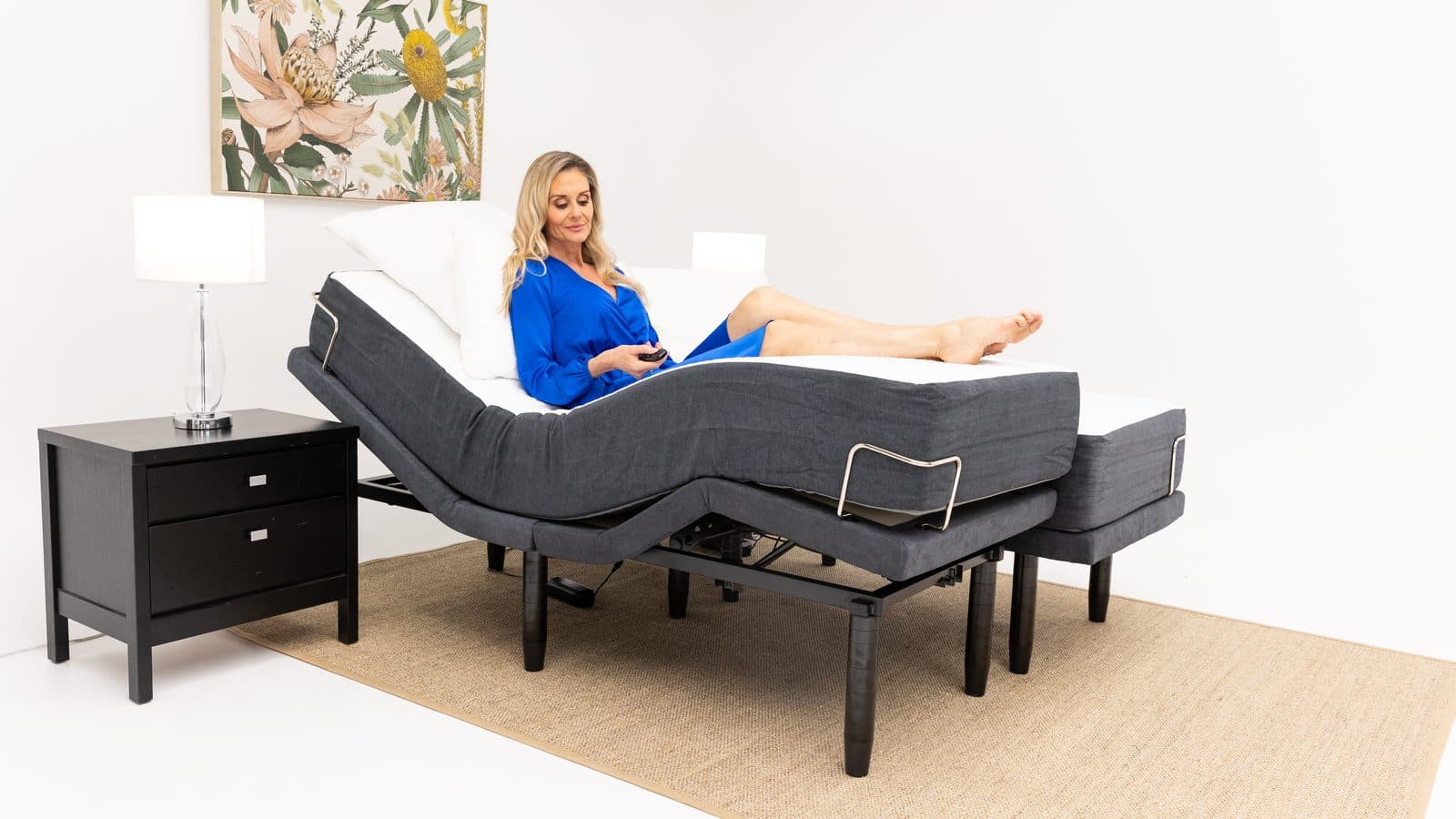
A massage function on an adjustable bed is a motor built into the base that vibrates, at an intensity you set, from the same remote that moves the head and foot sections. On a Sophie adjustable bed it is included on every model rather than sold as an upgrade. It is a comfort feature, and there is exactly one therapeutic claim attached to it that has been through a regulatory process.
This guide covers what the feature actually is, how to judge one, what it costs in the Australian market, and where the line sits between what is registered and what is marketing.
What a massage function actually is
The motor sits inside the bed base, under the mattress. Switch it on and the base vibrates; you feel that through the mattress at the intensity you choose. There is no separate device, nothing on top of the mattress, and nothing to put away.
Most people describe the sensation as similar to the first minute in a warm bath. At the lowest setting it is subtle; at the highest it is unmistakable, and most people settle in the lower half of the range and stay there.
Two terms get used for the same thing. “Massage” is what it is called on the remote and on the register; “whole-body vibration” is what it is called in marketing. They describe the same motor.
The one claim that is actually registered
Sophie adjustable beds and lift recliner chairs are ARTG-registered Class 1 medical devices (ARTG 326115), and that registration covers the massage function specifically. The intended purpose recorded on the register is that the massage feature “provides a massaging therapeutic effect and may assist in the reduction of aches and pains and improve sleep quality.”
That sentence is the ceiling, and we quote it exactly rather than paraphrasing it. It is worth knowing it exists, because it is the one claim in this category that has been through a regulatory process rather than a copywriting one.
What we will not sell you a bed on: circulation, lymphatic drainage, joint mobility, muscle recovery or detoxification. You will find all of those attached to vibrating beds elsewhere, usually supported by research into standing vibration platforms — a different product used in a different posture, where your whole body weight is loaded through your feet. Carrying a conclusion across that gap is a substitution rather than evidence.
If a retailer tells you a massage bed treats a condition, ask them to put it in writing on the invoice. The reaction tells you most of what you need to know.
A note on “therapeutic beds”
It is a common search term and a loose one. It generally means a bed sold on comfort or positioning benefits rather than on looks, which covers adjustable beds, hospital-style beds, pressure-care systems and a good deal of marketing.
The word “therapeutic” in a product name is not a regulated status. What is regulated is the claim: a device presented as treating, preventing or alleviating a condition generally belongs on the Australian Register of Therapeutic Goods, and the wording it may use is recorded against that entry. The register is public and an entry number is something a seller can hand you. That is the practical test rather than the adjective.
How to judge a massage bed
- Built in, or bolted on? A motor integrated into the base runs from one remote and leaves nothing to store. A vibrating pad or topper is a second device with its own handset, its own power lead, its own lifespan and its own warranty.
- Included, or an upgrade? Ask whether the quoted price covers it and get that in writing on the quote. On a Sophie adjustable bed it is included on every model at every size, with no separate line item.
- Can you vary the intensity? A single on/off setting is far less useful than a range. Most people want a low setting most of the time, which a fixed-level motor cannot give them.
- Are there separate zones? Some beds drive the head and foot sections independently. Whether that matters is personal — plenty of people never use it — so it is worth trying rather than paying for on principle.
- What happens on a shared bed? On one mattress, both of you feel it. On a split configuration each side is an independent base, so one side can run it while the other stays still.
- How noisy is it? There is a low hum while the motor runs. It is not silent and nobody should tell you it is. Ask to hear it somewhere quiet.
- Can you try it? Vibration is close to impossible to judge from a description. This is the feature where lying on it matters most.
Why you will not find a hertz figure here
Product pages often quote a vibration frequency, sometimes with a particular benefit attached to each band. We publish no hertz figure for the Sophie bed, because what you actually control is a set of intensity settings chosen by feel, and quoting a precise frequency would imply a precision the feature does not claim.
It is also worth knowing where those numbers usually come from. Specific frequency bands, and the claims attached to them, are drawn from research on standing vibration platforms. Lifted out of that context and printed on a bed page, they are decoration.
Using it
Start at the lowest intensity and work up. There is nothing to be gained by starting high, and people who do often decide they dislike the feature when what they actually dislike is the setting.
There is no prescribed session length, because it is a comfort setting rather than a treatment. Most people who use it regularly run it for a short stretch before sleep rather than leaving it on all night.
If you are pregnant, have an implanted medical device such as a pacemaker, or are recovering from surgery or a fracture, talk to your GP or treating clinician before using vibration.
What it costs
Queen and king adjustable beds in the Australian market run from roughly $5,000 to $24,000, and singles from about $3,000. That band is wide because it covers genuinely different products — motors, frame, the mattress that comes with it, warranty, and what the after-sales service actually is. A massage function is rarely what moves a bed from one end of that range to the other.
What varies more than you might expect is whether it is included at all. Some suppliers quote a base price and add the massage module; some include it. Ask which, and get it on the quote rather than in conversation.
On a Sophie adjustable bed it is part of every model. Current pricing by size is on the adjustable bed range page, which is always up to date — we keep prices there rather than in articles, because a figure written today is misleading in six months. Interest-free options are available through Humm, Brighte and Payright for approved purchasers.
Buying locally
We do not run showrooms. We bring the bed to your home, set it up, and leave you with it for 30 to 60 minutes so you can run the intensity settings yourself and decide whether it is something you would actually use. It is free, obligation-free, and it happens in the room the bed would live in. Delivery and professional installation anywhere in Australia are included and done by our own team.
Call 1300 9 SLEEP (1300 975 337) Monday to Friday, 9am–5pm AEST. For more on the feature itself, see vibrating beds and what they actually do.
Common questions
What does the massage function on an adjustable bed do?
A motor inside the bed base vibrates, and you feel it through the mattress at an intensity you set, from the same remote that moves the head and foot sections. Most people describe it as similar to the first minute in a warm bath. It is a comfort feature used lying down.
Is a massage bed a therapeutic device?
Sophie adjustable beds and lift recliner chairs are ARTG-registered Class 1 medical devices (ARTG 326115) for their massage function. The registered intended purpose is that it “provides a massaging therapeutic effect and may assist in the reduction of aches and pains and improve sleep quality”. That is the limit of what we claim. “Therapeutic” in a product name is not itself a regulated status — the claim is what is regulated.
Does the massage function cost extra?
It depends on the supplier, and it is worth asking directly. Some quote a base price and add a massage module; some include it. On a Sophie adjustable bed it is part of every model at every size with no separate line item. Get the answer on the written quote rather than in conversation.
What frequency does the massage run at?
We do not publish a hertz figure, because what you control is a set of intensity settings chosen by feel rather than a calibrated frequency. Specific frequency bands quoted online generally come from research on standing vibration platforms, which are a different product used in a different posture.
Will the massage disturb my partner?
On a single shared mattress, yes — the vibration travels across the bed. On a split configuration each side is an independent base with its own remote, so one side can run it while the other stays still.
What does an adjustable bed with massage cost in Australia?
Queen and king adjustable beds run from roughly $5,000 to $24,000 in the Australian market, and singles from about $3,000. A massage function is rarely what moves a bed from one end of that range to the other. Current Sophie pricing by size is on the adjustable bed range page rather than in this article.
Information on this page is general in nature and is not a replacement for professional medical advice. Talk to your GP, occupational therapist or treating clinician about what suits your situation.
This article is general information, not medical advice. For guidance on your situation, talk to your GP or occupational therapist.
Wondering if an adjustable bed would suit your situation?
Our sleep experts talk with Australians in similar situations every day. No pressure, no jargon — just honest answers about what may help you rest more comfortably.
1300 975 337 (1300 9 SLEEP) · Australian-based team · Explore the Sophie adjustable bed range
Rated 4.8 from 227 reviews on ProductReview.com.au · Free in-home demonstration · Interest-free options via Humm, Brighte & Payright for approved purchasers
Using NDIS or Support at Home funding?
Sleep Sophie is a registered NDIS provider (4050070896), and Sophie adjustable beds and lift recliners are ARTG-registered Class 1 medical devices (ARTG 326115). Beds can be funded through NDIS assistive-technology budgets where an occupational therapist recommends them; the Support at Home program has its own equipment pathway. We prepare quotes suitable for plan approval — see how NDIS funding works or Support at Home, or call and we’ll walk you through it.