
Vibrating Beds: What They Actually Do
1 February 2026 · Nathan Kerrins · Updated 22 September 2026
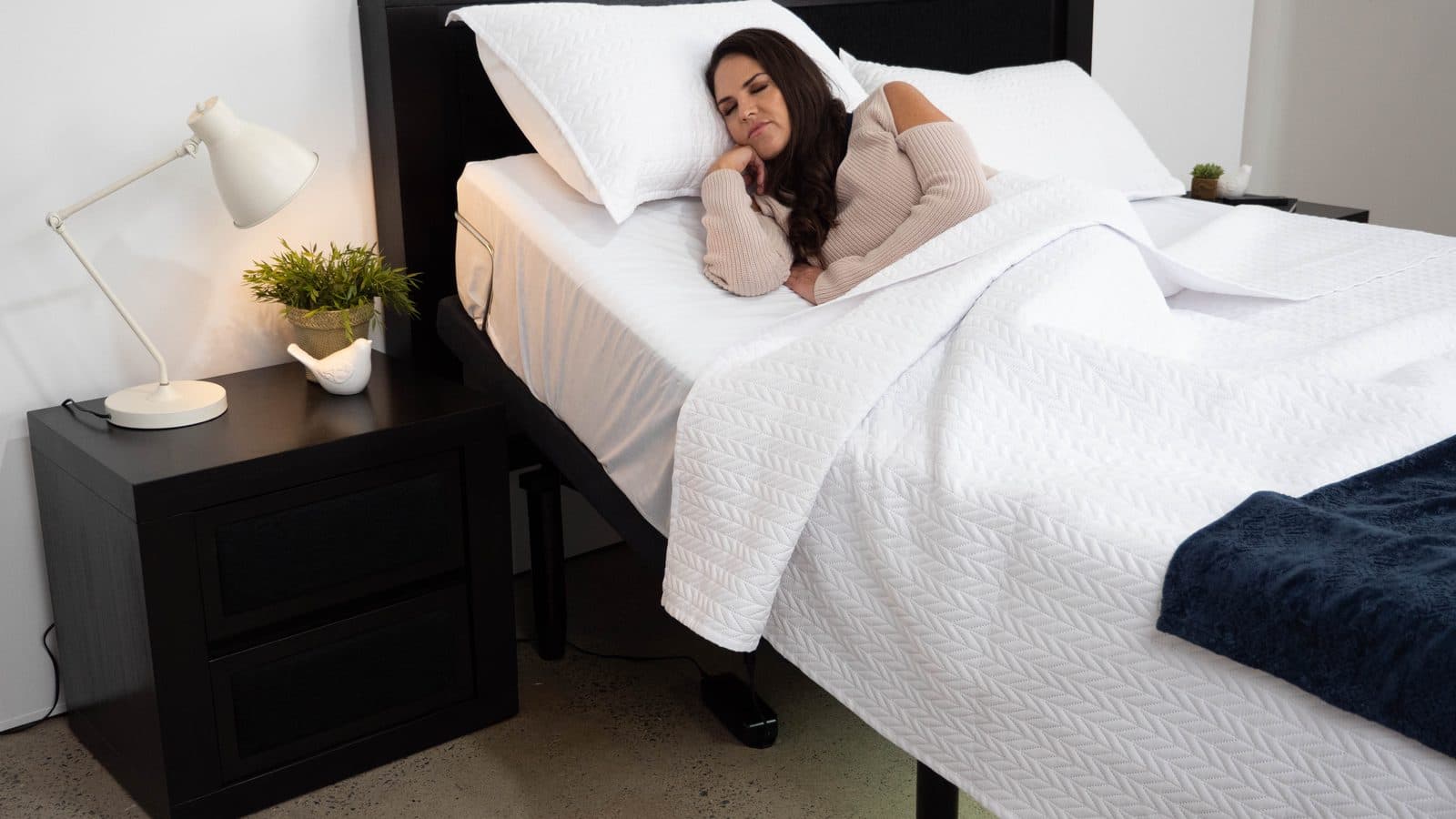
A vibrating bed has a motor built into the bed base. Switch it on and the base vibrates; you feel that through the mattress you are lying on, at an intensity you choose, from the same wireless remote that raises the head and foot sections. It is a comfort feature rather than exercise equipment — you use it lying down, usually while winding down for sleep. On a Sophie adjustable bed it is included on every model rather than sold as an upgrade.
Almost everything written online about “whole body vibration” borrows its language from gym vibration plates, which are a different product, used standing up, for a different purpose. This guide sticks to the bed: what it is, what it is for, what we are and are not licensed to claim about it, how to judge one, and how to look after it.
What a vibrating bed actually is
The motor sits inside the bed base, under the mattress. When you switch it on, the base vibrates and the mattress carries that vibration to you. There is no separate box to plug in, nothing sitting on top of the mattress, and nothing to put away in the morning.
On a Sophie adjustable bed it runs from the same wireless remote as the head and foot presets, with multiple intensity settings, and it is included at no extra cost rather than quoted as an optional module. The same remote also drives the position presets, so moving from a flat bed to legs-raised-with-vibration is a couple of button presses rather than a second device.
“Vibrating mattress” — the phrase people use, and what it usually means
A lot of people search for a vibrating mattress, a vibrating bed mattress, or a mattress that vibrates. It is worth being clear about what is actually for sale, because three quite different things get sold under those words:
- A bed base with vibration built in, sold with a mattress on top. The mattress itself contains no motor and no electronics — it simply transmits what the base does. This is what a Sophie adjustable bed is.
- A pad or topper with a motor inside it, laid on an ordinary mattress and run from its own handset and power lead. Here the vibrating part really is on top of the bed.
- A standalone vibration platform, which is not bedding at all — you stand on it.
So if a listing advertises a “vibrating mattress”, the useful question is where the motor lives. That single answer tells you what you are buying, what you will have to store, and what happens when one part of it wears out.
What it feels like
Most people describe it as similar to the first minute in a warm bath — a steady, even vibration through the surface underneath you, strong enough to notice and easy to ignore once you have settled. At the lowest setting it is subtle. At the highest it is unmistakable, and most people find they do not want it there for long.
It is worth saying plainly that this is a matter of taste. Plenty of owners use it every night as part of getting to sleep. Plenty of others try it a few times, decide it is not for them, and never touch the button again. Neither reaction is unusual, and no one should feel they have paid for something they are obliged to like.
What it is for — and what we will not claim
People ask what the point of a vibrating bed is, and it is a fair question. The honest answer is that it is a relaxation and comfort setting. It gives you something pleasant to do with the last ten minutes before sleep, or a way to settle back down if you have woken at three in the morning and your body feels restless. That is the reason the feature exists, and for most people it is reason enough.
The one therapeutic claim that is actually registered
Sophie adjustable beds and lift recliner chairs are ARTG-registered Class 1 medical devices (ARTG 326115), and that registration covers the massage function specifically. The intended purpose recorded on the register is that the massage feature “provides a massaging therapeutic effect and may assist in the reduction of aches and pains and improve sleep quality.”
That is the wording on the register, and it is the limit of what we will say. We quote it here because it is the one claim in this category that has actually been through a regulatory process, and because knowing what that sentence does and does not cover is genuinely useful when you are reading someone else's product page.
Everything past that line
We will not sell you a vibrating bed on circulation, lymphatic drainage, joint mobility, muscle recovery, bone density, weight loss or detoxification — all of which you will find on other pages in this category. There are two reasons for that.
The first is that the research those pages lean on is almost always research into standing vibration platforms — a different device, a different load on the body, a different posture, a different intensity. Borrowing a platform study to sell a bed is not evidence; it is a substitution.
The second is simpler: we have not tested it, so we cannot stand behind it. If a retailer tells you a vibrating bed treats a condition, ask them to put it in writing on the invoice. The answer to that request is informative.
What an adjustable bed genuinely does is change your position, and that is the base doing the work rather than the vibration. Raise your head to help to alleviate snoring, or lift your legs above your heart to help ease swelling. Those two are worth keeping mentally separate from the vibration feature, because they come from the geometry of the bed, not the motor.
Vibrating bed, vibrating topper, or vibration plate?
These three get written about as though they were variations on one product. They are not. The differences are practical, and they show up in daily use rather than on a spec sheet.
| Vibrating bed | Vibrating topper or pad | Vibration plate | |
|---|---|---|---|
| Where the motor sits | Built into the bed base | Inside a pad laid on the mattress | A standalone platform |
| How you control it | The same remote as the head and foot positions | Its own controller and power lead | Its own panel |
| Used while | Lying in bed | Lying in bed | Standing |
| Extra to store or plug in | Nothing | A pad, a cable and a handset | A separate machine |
| What you feel through | The whole mattress | The pad, under your sheet | Your feet and legs |
| If it stops working | Service call on the bed | Replace the pad | Replace the machine |
| Who it tends to suit | Someone buying an adjustable bed anyway | Someone keeping their current bed | Someone after exercise equipment |
The topper is the honest middle option if you are not replacing your bed. It costs less, it works, and it is easy to move. The trade-offs are that it is another device with its own lifespan and its own warranty, it lies between you and your mattress, and it has a cable running to a power point beside the bed.
The plate is not bedding and should not be compared to bedding. If you find a page citing plate research while selling you a bed, treat the rest of that page with caution.
How to judge a vibrating bed
There is no meaningful ranking to give you here, because the feature is close to identical in function wherever you buy it and the differences that matter are about the bed around it. These are the questions worth asking whoever you are talking to.
- Is it built in, or bolted on? A motor integrated into the base runs from one remote and leaves nothing to store. A pad is a second device with a second cable and a second thing to replace.
- Is it included, or an upgrade? Ask whether the quoted price already covers it, and get that in writing on the quote. On a Sophie adjustable bed it is included on every model and there is no separate line item for it.
- Can you vary the intensity? A single on/off setting is far less useful than a range. Most people settle on the lower half and stay there, which they could not do with one fixed level.
- What happens on a shared bed? On one mattress, both people feel it. On a split configuration each side is an independent base with its own remote, so one side can run vibration while the other stays completely still.
- How noisy is it, in a quiet room? Showroom floors are noisy places and bedrooms at 10pm are not. Ask to hear it somewhere quiet.
- Who fixes it, and for how long? Sophie adjustable beds carry a 5-year comprehensive warranty as standard, extendable to 10 years, with our own team doing delivery and installation anywhere in Australia. Whoever you buy from, find out whether a fault means a service visit or a freight return.
- Can you try it before you commit? Vibration is close to impossible to judge from a description. Being able to lie on it matters more here than with almost any other feature on the bed.
A note on frequency figures
Product pages often quote a vibration frequency in hertz, and buyers reasonably go looking for that number. We do not publish one for the Sophie bed, because what you actually control is a set of intensity settings rather than a calibrated frequency, and quoting a precise figure would suggest a precision the feature does not claim.
It is worth knowing where those numbers usually come from. Specific hertz bands, and the claims attached to them, are drawn from research on standing vibration platforms, where the person's whole body weight is loaded through the plate. A figure lifted from that literature and printed on a bed page is not describing the bed. If frequency matters to you, that is a genuine reason to look at a platform rather than a bed — they are different products for different purposes.
Is it noisy, and will it disturb my partner?
There is a low hum while the motor runs. It is not silent and no one should tell you it is. In a quiet bedroom you will hear it, in much the same way you hear a fan on a low setting — present, steady, and easy to stop being aware of. It is quieter at lower intensities, which is another reason most people settle in the lower half of the range.
The partner question has a clearer answer, and it depends entirely on the configuration. On a single shared mattress the vibration travels across the whole surface, so if one of you turns it on, both of you are in it. That is worth agreeing on in advance rather than discovering at eleven at night.
On a split configuration — a Split Queen, Split King or Split Cali King — each side is a separate base with its own motor and its own remote. One side can run vibration at any setting while the other side stays still. For couples who disagree about this feature, and there are many, the split is the answer rather than a compromise on intensity.
Using it, and looking after it
None of this is complicated, but it is the part most guides skip in favour of benefit claims.
Using it
Start at the lowest intensity and work up from there. There is nothing to be gained by starting high, and people who do usually decide they dislike the feature when what they actually dislike is the setting. Treat it as part of winding down rather than as something to get through: if it stops being pleasant, turn it off.
There is no prescribed session length, because it is a comfort setting rather than a treatment. Use it for as long as you find it pleasant. Most people who use it regularly run it for a short stretch before sleep rather than leaving it on all night.
When to check with someone first
If you are pregnant, have an implanted medical device such as a pacemaker, or are recovering from surgery or a fracture, talk to your GP or treating clinician before using vibration. This is not a long list and it is not meant to alarm anyone, but it is the list, and a retailer who tells you there are no considerations at all is not being straight with you.
Looking after it
The vibration motor lives inside a sealed base and is not a part you maintain. What you can usefully do:
- Keep the floor under the bed clear. The base needs its six legs on firm, level footing. Storage boxes wedged underneath can put the frame out of level, and an unlevel base is the most common cause of a rattle that sounds like a motor fault.
- Check the power lead has slack. The base moves through its full range every time you use the position presets. The lead should be routed so it never pulls tight or catches as the bed articulates.
- Change the remote batteries before you troubleshoot anything else. A remote with failing batteries produces exactly the symptoms people report as motor faults — intermittent response, one function working and another not.
- Listen for changes rather than noise. A steady hum is normal. A new grinding, knocking or intermittent sound is worth a phone call, and it is covered.
- Do not open the base. There is nothing user-serviceable inside it, and opening it will cost you the warranty you are trying to use.
What it costs
For general context, queen and king adjustable beds in the Australian market run from about $5,000 to $24,000 depending on the base, the motors, the mattress and the warranty behind it. That band is wide because it covers very different products, and vibration is rarely what moves a bed from one end of it to the other.
On a Sophie adjustable bed, whole-body vibration is part of every model rather than an add-on module, so it is included at every size rather than quoted separately. Current pricing for each size is on the adjustable bed range page, which is always up to date — we deliberately do not print prices in articles, because a figure written today is a misleading figure in six months. Every Sophie bed also includes the four-layer Australian-made mattress, free delivery and free professional installation Australia-wide. Interest-free payment options are available through Humm, Brighte and Payright, with no-deposit options for approved purchasers.
If you are pricing a vibrating topper instead, the sticker price is the easy part. Factor in that it is a separate device with its own lifespan, its own warranty and its own power lead, and that replacing it later is a purchase you make again rather than a service call.
Who uses it, and who does not bother
In our experience delivering these beds, the feature divides people more sharply than any other part of the bed. Some owners use it nightly and would miss it. Others run it a handful of times out of curiosity and then leave it alone for years. Both groups bought the same bed and neither made a mistake.
That is also why it is worth knowing it is included rather than paid for separately. Nobody has to justify the decision or feel they wasted money on a setting they did not take to — the bed is the purchase, and this is one of the things it does.
One practical note, because it comes up in searches: this is a feature on an adult bed, sized and built for adults, and the weight rating on a Sophie adjustable bed is 320kg. It is not related to the vibrating pads sold for settling infants, which are an entirely separate category of product with their own safety guidance.
Try it in your own bedroom
We do not run showrooms — we bring the bed to you. A free in-home demonstration means our team sets the bed up in your own room and you spend 30 to 60 minutes with it, running the intensity settings yourself and working out whether it is something you would genuinely use. It is obligation-free and there is no cost.
That matters more with this feature than with most. A description cannot tell you whether you will like being vibrated, and neither can a noisy showroom floor. Lying on it in your own bedroom can.
Call 1300 9 SLEEP (1300 975 337) Monday to Friday, 9am–5pm AEST. For the wider picture, see our guide to vibrating beds in Australia, or the Sophie adjustable bed range.
Common questions
What is the point of a vibrating bed?
It is a relaxation and comfort setting. It gives you something to do with the last ten minutes before sleep, or a way to settle back down after waking in the night. On a Sophie adjustable bed the massage function is ARTG-registered (ARTG 326115); the registered intended purpose is that it “provides a massaging therapeutic effect and may assist in the reduction of aches and pains and improve sleep quality”. That is the limit of what we claim for it.
How does a vibrating bed feel compared to a regular mattress?
Most people describe it as similar to the first minute in a warm bath — a steady, even vibration through the surface you are lying on, at an intensity you set. At the lowest setting it is subtle; at the highest it is unmistakable. It is easy to stop, and it is a comfort feature rather than a treatment.
Is a vibrating mattress the same as a vibrating bed?
Usually not, and the difference is where the motor lives. A vibrating bed has the motor inside the bed base, with an ordinary mattress on top that simply carries the vibration. A vibrating mattress topper or pad has the motor inside a pad you lay on the mattress, with its own handset and power lead. Ask which one a listing means before you compare prices.
What's the difference between a vibrating bed and a vibration plate?
A vibrating bed has the motor built into the bed base and is used lying down, controlled from the same remote as the head and foot positions. A vibration plate is a standalone platform you stand on, used for exercise. Most research and marketing about “whole body vibration” refers to the plate, not the bed.
Is a vibrating bed noisy?
There is a low hum while the motor runs — audible in a quiet bedroom, roughly like a fan on a low setting, and quieter at lower intensities. It is not silent, and anyone who tells you it is has not listened to one in a quiet room.
What frequency does a vibrating bed run at?
We do not publish a hertz figure for the Sophie bed, because what you control is a set of intensity settings rather than a calibrated frequency. Specific frequency bands quoted online almost always come from research on standing vibration platforms, which are a different product loaded through your whole body weight. If a precise frequency matters to you, that points to a platform rather than a bed.
Does the vibration cost extra on a Sophie bed?
No. Whole-body vibration is included on every Sophie adjustable bed rather than sold as an upgrade. There is no separate module and no extra line item. Current pricing for each size is on the adjustable bed range page.
Will the vibration disturb my partner?
On a single shared mattress, yes — the vibration travels across the bed, so a partner will feel it while it is on. On a split configuration each side is an independent base with its own remote, so one side can run vibration while the other stays still.
Is there anyone who shouldn't use it?
If you are pregnant, have an implanted medical device such as a pacemaker, or are recovering from surgery or a fracture, talk to your GP or treating clinician before using vibration. This is general information and not medical advice.
How long should I use it for?
There is no prescribed session length, because it is a comfort setting rather than a treatment. Start at the lowest intensity, use it for as long as you find it pleasant, and turn it off when you don't.
Information on this page is general in nature and is not a replacement for professional medical advice. Talk to your GP, occupational therapist or treating clinician about what suits your situation.
Compare the Sophie range with a real person
No call centres, no scripts — tell us what you need and we’ll give you straight answers on fit, delivery and funding.
1300 975 337 (1300 9 SLEEP) · Australian-based team · Explore the Sophie adjustable bed range
Rated 4.8 from 227 reviews on ProductReview.com.au · Free in-home demonstration · Interest-free options via Humm, Brighte & Payright for approved purchasers
Using NDIS or Support at Home funding?
Sleep Sophie is a registered NDIS provider (4050070896), and Sophie adjustable beds and lift recliners are ARTG-registered Class 1 medical devices (ARTG 326115). Beds can be funded through NDIS assistive-technology budgets where an occupational therapist recommends them; the Support at Home program has its own equipment pathway. We prepare quotes suitable for plan approval — see how NDIS funding works or Support at Home, or call and we’ll walk you through it.
Ask us about this bed
Free delivery and installation, Australia-wide — tell us what you’re after and we’ll get back to you with straight answers.