
Adjustable Bed Myths, Busted: What Australian Buyers Need to Know
5 August 2026 · Nathan Kerrins
Sleep Sophie is a registered NDIS provider, and Sophie adjustable beds are ARTG-registered (ARTG 326115). We're rated 4.8 from 227 reviews on ProductReview.com.au — and we spend our days answering these exact questions in people's bedrooms.
If you've started researching adjustable beds, you've probably noticed the information doesn't add up. One website says you can keep your existing mattress; another says you can't. A friend insists they're hospital beds. A forum thread swears the motors fail. And somewhere along the way you've heard they all cost five figures — minimum. It's a considered purchase, and you deserve straight answers.
At Sleep Sophie, we run free in-home demonstrations across Australia, so the same myths come up again and again — 25 of them, by our count. This article puts the thirteen that matter most to bed; the rapid-fire round at the end covers the other twelve.
Are adjustable beds just hospital beds?
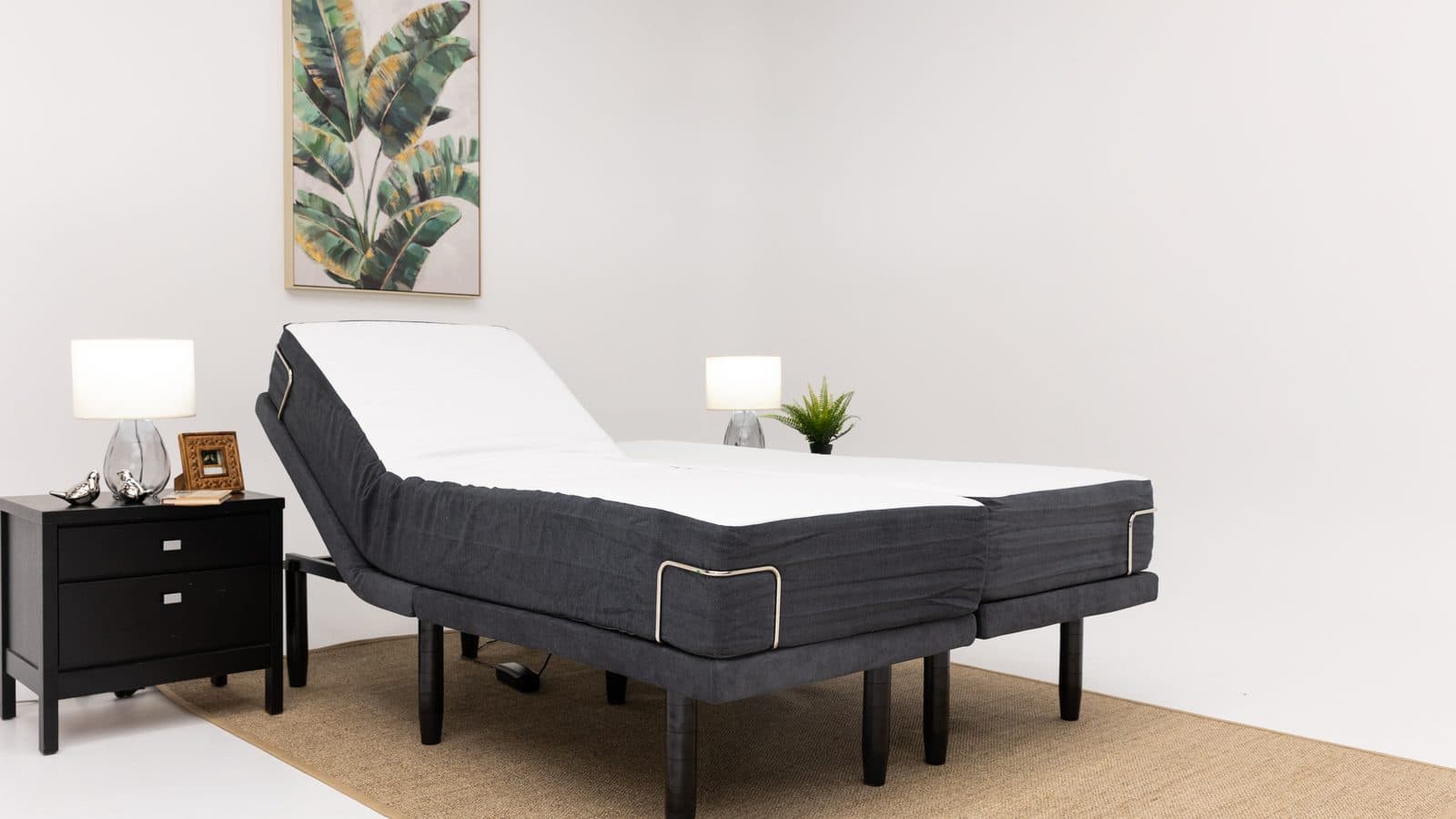
No. Modern adjustable beds look like premium bedroom furniture — upholstered bases, stylish bedheads and luxury mattresses, nothing clinical. Adjustable beds are now one of the fastest-growing bedding categories in Australia, stocked by specialist sleep retailers and many of the country's biggest bedding stores, and people buy them for comfort, not because they're unwell.
That hospital-bed image might have been fair 20 years ago. Not anymore. Today's adjustable beds look like any other premium bedroom suite — until you press the remote. People aren't buying them because they're sick; they're buying them because reading, watching TV and finding the right sleeping position are all easier when the bed moves with you. Sleep Sophie's range is built exactly this way: premium fabrics, contemporary bedheads, nothing that belongs in a ward.
Are adjustable beds only for elderly people?
No. Adjustable beds suit anyone who wants more comfort and flexibility from their bed — they're used by people of all ages, including elite athletes and professional sporting organisations, because sleep plays a big part in recovery and performance. Sleep needs change throughout life, and an adjustable bed lets you adapt your position at 25 or 85.
Older Australians do love them, especially where mobility or joint comfort is a factor. But the runner elevating tired legs gets just as much out of one as the reader sick of stacking four pillows. The position that feels right at 30 rarely feels right at 60 — the bed that adjusts is the bed that keeps up.
Are adjustable beds too firm to be comfortable?
No — because the base isn't what you feel, and comfort is set by the mattress, not the mechanism. Comfort comes from the mattress, and purpose-designed adjustable mattresses come in different feels, from softer and more cushioning through to firmer support. The idea that an adjustable bed must be hard comes from that old hospital image, not from any modern adjustable bed.
Sleep Sophie's mattresses are Australian-made, built from four foam layers. On top is Hygroflex®, a high-resilience comfort foam that fuses the qualities of memory foam and latex — independently tested by RMIT University's School of Engineering to conform to the body up to 67% better, dissipate heat up to 27% faster, and reduce pressure up to 32% better than traditional memory foam. Beneath it sit a NextGen™ comfort layer, a medium transition layer and a firm support base. And there's a second comfort lever a flat bed doesn't have: position. Raise your head a touch, lift your legs, or use the Zero Gravity preset. For many people, the surprise isn't that an adjustable bed is comfortable enough — it's that it's more comfortable than the flat bed it replaced.
Do adjustable beds help with snoring?
For some people, yes. Sleeping completely flat means gravity can affect the position of your airways, which may contribute to snoring. Elevating your upper body creates a more supported position that can make breathing feel more comfortable — without stacking pillows. Snoring has many causes, though, and an adjustable bed is not a replacement for professional medical advice.
What owners tend to notice is how small the adjustment needs to be. A gentle lift of the head section can mean a more peaceful night for both people in the bed, and a split configuration lets one side elevate while the other stays flat. If snoring is a persistent concern, talk to your GP; if it's an occasional annoyance, position is an easy thing to experiment with.
Are adjustable beds noisy?
Modern premium adjustable beds are whisper-quiet. Sleep Sophie uses premium Okin motors — one of the most recognised names in the adjustable bed industry — engineered for smooth, quiet movement that won't disturb a partner, whether you're raising your head to read or returning the bed to flat at midnight.
The noisy-bed reputation belongs to an earlier generation of products. Motor quality is one of the clearest dividing lines between a cheap adjustable bed and a premium one (more on that below), and quietness is where you notice it first. Ask our customers what surprised them most and this answer comes up constantly.
Hear it for yourself. The quietest way to settle this myth is a free in-home demonstration — 45 to 60 minutes, in your own bedroom, no showroom trip. Or call 1300 9 SLEEP and chat to a Sophie expert first.
How much does an adjustable bed cost in Australia?
Not five figures, in most cases. Quality adjustable beds are available across a wide range of price points — across the Australian market, queen adjustable beds broadly run from around $5,000 to $24,000, and singles from around $3,000 to $13,000, depending on what you choose. What moves the price is what's underneath: motor quality, frame strength, mattress materials, included features, warranty, and the level of service behind the product — much like the difference between a basic car and a premium one.
Features like Zero Gravity presets, independent head and foot adjustment, under-bed lighting, USB charging, stronger frames and a mattress genuinely designed for adjustable movement all add cost — and all change how the bed feels to live with. The most expensive option isn't automatically right for you, either. The sensible question isn't "how much should I pay for an adjustable bed?" but "what am I getting for my investment?" — this is a product you'll use every night, usually for many years. For current Sophie pricing, see the adjustable bed range.
Are adjustable beds worth it, or just a gimmick?
Are adjustable beds worth it? For many owners, yes — because they solve real, daily comfort problems. A flat mattress offers exactly one position; an adjustable bed adapts to your body instead of forcing your body to adapt to it. That's not added technology for its own sake — it's more control over how you rest, read and sleep.
Think about what a single flat position asks of you. Reading means propping yourself on a pillow pile. Tired legs stay level all night. Getting up with stiff joints means pushing off from flat. An adjustable bed answers each with a button press — leg elevation to take pressure off the lower back, a proper sitting position for reading or TV, a raised head section that makes getting in and out easier. Gimmicks don't get used every single day. This does.
Aren't all adjustable beds basically the same?
No — and this is the most expensive myth on the list. From the outside, two adjustable beds can look nearly identical: both move, both come with a remote. What differs is everything you can't see — motor quality, frame strength, weight rating, mattress design, and the after-sales support behind the product.
That gap is exactly why the cheapest bed and a premium bed are not the same product at different prices. One is engineered for years of daily, repeated movement; the other is built to a price tag.
How do I choose a good adjustable bed in Australia?
There's no single "best adjustable bed" in Australia — the right bed depends on your body, budget and bedroom. Compare five things: the motor brand and its reputation; the frame strength and weight rating; whether the mattress is purpose-designed for the base; the warranty and after-sales support; and whether you can try the bed where you'll actually use it.
On those five, here's where Sleep Sophie stands: premium Okin motors; a 320kg-rated frame; an Australian-made, four-layer mattress (with the RMIT-tested Hygroflex® top layer) matched to our bases; a 5-year comprehensive warranty, standard; ARTG registration (ARTG 326115); and a free in-home demonstration in your own room. Whoever you buy from, insist on clear answers to all five — a quality supplier will have them ready.
Can I use my existing mattress on an adjustable bed?
Usually not — and if it's a traditional inner-spring mattress, no. Inner-spring mattresses are built around interconnected metal springs and wires engineered to support you on a flat surface. Forcing one to bend on an adjustable base can damage that internal structure — even a single bend can ruin it, so the mattress never returns properly to flat.
This is one of the most common — and costliest — mistakes people make when buying an adjustable base on its own. An adjustable bed needs a mattress specifically designed to flex, move and recover with the base every day. The mattress and base aren't two separate products; they're one sleep system. That's why Sleep Sophie designs its adjustable sleep systems as a complete package, matching each Australian-made mattress to its base so the pair works exactly as intended. The base is only half the system — the right mattress is what delivers the comfort you're paying for.
Can you try an adjustable bed before you buy it?
Yes — and you don't need a showroom to do it. Sleep Sophie offers free in-home demonstrations across Australia: a 45–60 minute session where you test positions, feel the mattress support and ask questions in the room where the bed will actually live — your own bedroom.
A showroom can be a fine experience, but it isn't your space. Testing the bed in your bedroom answers questions no showroom can — will it suit the room, how quiet is it at night, how does Zero Gravity feel under your own doona. It also settles the online-buying worry: buying an adjustable bed online is safe when the company backs it with genuine service — guidance before you decide, a demonstration before you commit, support after delivery. You're not imagining how the bed might feel at home. You're experiencing it there.
The rapid-fire round: 12 more myths, busted
Every myth below gets a full answer on our Adjustable Bed Myths FAQ page.
- "Online companies can't provide personal service." Great service isn't about where you buy from — Sleep Sophie pairs online convenience with personalised guidance and a free in-home demo. Full answer →
- "You need a whole new bedroom suite." An adjustable bed slots into the bedroom you already have — keep your furniture, keep your bedding. Full answer →
- "They don't help with circulation." Leg elevation at the touch of a button takes pressure off your lower body and creates a more relaxed resting position — one of the most-used features on any adjustable bed. Full answer →
- "You need a medical condition to justify one." Most people buy for everyday comfort — reading, TV, relaxing. No diagnosis required. Full answer →
- "They're only for people with back pain." Back support is one benefit of many, alongside leg elevation, easier getting in and out of bed, and plain everyday comfort. Full answer →
- "The motors break easily." Premium Okin motors are engineered for years of daily, repeated movement — many customers adjust their bed several times a day. Full answer →
- "They're complicated to operate." One wireless remote, preset positions including Zero Gravity, and a flat button. Most customers master it in minutes. Full answer →
- "You can't use your own doona and pillows." Your existing doona, blankets and pillows work perfectly — only the fitted sheet needs to match your mattress size. Full answer →
- "They take up more space than a normal bed." Same standard Australian sizes — Long Single through to King — and the same footprint; all the movement happens within the frame. Full answer →
- "You have to sleep sitting upright." You choose the position: flat, a slight elevation, Zero Gravity, or anything in between. Full answer →
- "You can't sleep on it all night." You absolutely can — many owners sleep in their preferred position all night, every night. Full answer →
- "You need special sheets." Standard fitted sheets in your mattress size work fine — and the TV position actually makes bed-making easier. See our guide to sheets for adjustable beds. Full answer →
Put the myths to bed — in your own bedroom
Most adjustable bed myths survive for one simple reason: the people repeating them have never actually lain on one. Five minutes with the remote in your hand settles more arguments than any article can.
So here's the invitation. Book a free in-home demonstration — 45 to 60 minutes, in your own bedroom, no obligation. Or start by exploring the Sophie adjustable bed range, available in all standard Australian sizes from Long Single to King, with split options for couples.
NDIS participant, or caring for one? Sleep Sophie is a registered NDIS provider — the Sophie HiLo adjustable bed range is designed with participants, carers and occupational therapists in mind.
Compare the Sophie range with a real person
No call centres, no scripts — tell us what you need and we’ll give you straight answers on fit, delivery and funding.
1300 975 337 (1300 9 SLEEP) · Australian-based team · Explore the Sophie adjustable bed range
Rated 4.8 from 227 reviews on ProductReview.com.au · Free in-home demonstration · Interest-free options via Humm, Brighte & Payright for approved purchasers
Ask us about this bed
Free delivery and installation, Australia-wide — tell us what you’re after and we’ll get back to you with straight answers.