
Adjustable Beds for Narrow Bedrooms: What Actually Fits
19 May 2026 · Nathan Kerrins · Updated 24 September 2026
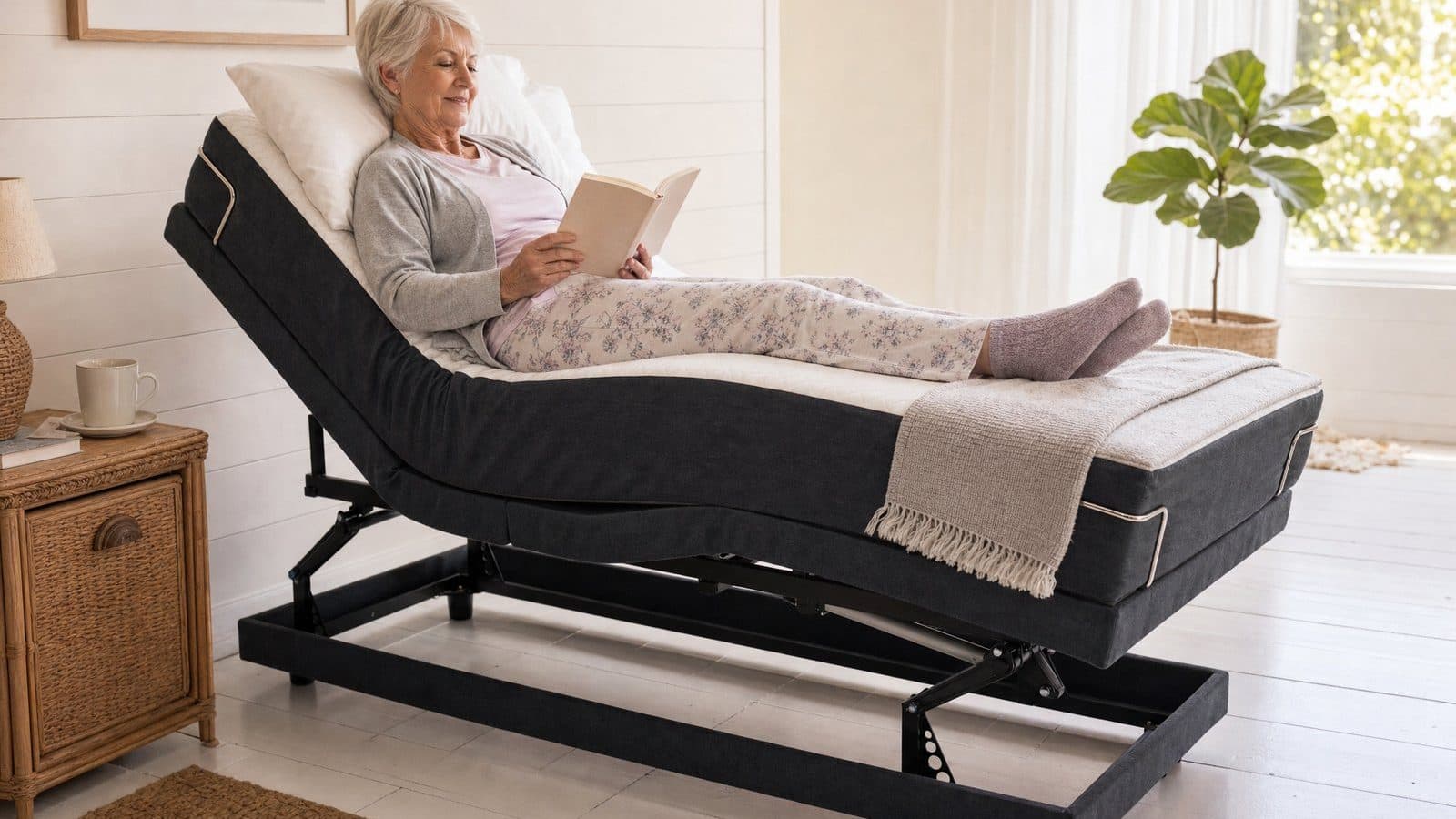
In a narrow bedroom the constraint is almost never the bed's thickness. It is the floor you have left over — how much room there is to walk past it, open a wardrobe, swing the door, and get in and out safely. An adjustable base takes the same footprint as a flat one of the same size. What it adds is a power lead, a little clearance to articulate, and a height you get to choose.
This guide is about the room rather than the product. Measure first, work out what will actually fit, and the bed decision mostly makes itself.
Measure the room, not the bed
Four numbers decide everything, and people usually only take the first.
- Wall to wall, at floor level. Skirting boards eat a couple of centimetres each side, and they are at exactly the height a bed base sits.
- The walking gap you need. Allow at least 60cm down one side to pass comfortably. If someone uses a walking frame or a wheelchair, 90cm is the working figure, and it needs to be clear the whole way.
- The door swing. Stand in the doorway and open the door fully. Where it lands is floor you cannot use.
- Wardrobe and cupboard doors. A hinged wardrobe door needs its own arc. This is the one that catches people out after the bed has arrived.
Add the walking gap to the bed width before you compare anything to the room. A 92cm bed in a 250cm room is comfortable. The same bed in a 180cm room with a wardrobe on one wall is not.
Which size actually fits
Every Sophie bed except the Double is 203cm long, so length is usually fixed and width is the variable.
| Size | Width | Room width it works in |
|---|---|---|
| Long Single | 92cm | From about 210cm with one clear side |
| King Single | 107cm | From about 225cm with one clear side |
| Double | 137cm | From about 255cm, and it is 187cm long rather than 203cm |
| Queen | 154cm | From about 275cm with one clear side |
Those room widths assume access down one side only, with the other side against a wall. If the bed needs to be reachable from both sides — which it does if someone is helped in and out of it — add another 60cm to 90cm and the numbers change considerably.
The Long Single is the one most people in a genuinely narrow room end up with. There is more on the size in our guide to Long Single adjustable beds.
Height is a choice, not a fixed spec
A common worry is that an adjustable base will sit too high and dominate a small room. It does not have to.
The Sophie base sits on six legs and the height is set anywhere between 47.5cm and 65cm, floor to base, at installation. Our team sets it on the day to suit the person using it, so it is a decision rather than a default you have to live with.
Two things worth thinking about before that visit. A lower bed looks less imposing in a small room and leaves more visual space above it. A higher bed is easier to get in and out of, because the ideal is usually feet flat on the floor with knees at roughly a right angle when seated on the edge. In a small room those two pull in opposite directions, and the person using the bed should win.
What an adjustable base needs that a flat bed doesn't
Three things, none of them large, all of them worth knowing before delivery day.
- A power point within reach. The base needs mains power, and the lead has to be routed so it never pulls tight as the bed moves through its range. In an older house with one power point behind where the bedhead goes, this can genuinely decide which wall the bed lives on.
- Clearance to articulate. When the head section rises, the mattress moves up and slightly back. It needs air behind it rather than a bedhead pressed hard against the wall. A few centimetres is enough, but zero is not.
- Nothing wedged underneath. The six legs need firm, level footing. Storage boxes pushed under the base can put the frame out of level, and an unlevel base is the most common cause of a rattle people mistake for a motor fault.
Keeping an existing bed frame
Plenty of frames work. The base has to sit inside the frame with room to bend, so the things to check are a centre rail, fixed slats, or a lip running along the inside edge.
In a small room there is a second consideration: a frame adds width. If the room is tight, going without a frame recovers ten to fifteen centimetres and often looks cleaner. The base is a finished piece of furniture in its own right rather than something that needs hiding.
If you are keeping a frame you like, measure the internal dimensions and get written confirmation from the supplier that the base fits before you order.
Split configurations, honestly
A split bed gives two people independent sides, which is genuinely the answer to most shared-bed problems. It is also wider than most narrow rooms allow.
A Split King is 2 x 92cm, so 184cm of bed before you add any walking space. In a room narrow enough to be reading this guide, that is usually not going to work. A Split Queen at 2 x 77cm is 154cm and sometimes will.
If the room cannot take a split and two people disagree about positions, two separate Long Singles side by side is the same arrangement arrived at differently, and each one can go in when the room allows.
What people mean by a “slimline” bed
It is a common search and it is not a size name, so it is worth unpicking. People asking for a slimline adjustable bed generally want one of three things, and they have different answers.
- Narrow. The smallest footprint available — a Long Single at 92cm.
- Low. A base that does not tower over a small room. That is the 47.5cm end of the height range, set at installation.
- Visually light. Something that does not read as a bulky medical-looking frame. Going without a bed frame does more for this than any specification, and so does under-bed lighting, which lifts the base visually off the floor at night.
Worth being straight about the trade-off: an adjustable base contains motors and a frame engineered to bend under load, so it is a more substantial object than a slat base. It can be narrow and it can be low. It is not going to be flimsy, and you would not want it to be.
Noise, which matters more in a small room
The motors make a low hum for a few seconds while the bed moves. In a large room it disappears. In a small room with hard floors and close walls, sound reflects and the same motor reads as louder.
Nothing dramatic follows from that, but two things help. Soft furnishing — a rug, curtains, a fabric bedhead — absorbs a surprising amount in a small space. And the noise only happens while the bed is actually moving, so it matters at the point you settle down rather than through the night.
If a light sleeper shares the room, the more relevant issue is not the motor but the mattress: on a single shared mattress, one person adjusting their position moves the other. A split configuration solves that, and in a narrow room it usually will not fit, which is worth knowing before rather than after.
Getting it into the room
This is the practical step small-room guides skip, and it is the one that occasionally stops a delivery.
An adjustable base is heavy and it does not fold. Before you order, walk the route it has to travel: the front door, the hallway, any turn at the top of a staircase, and the bedroom doorway itself. The tight spot is almost always a corner rather than a straight run — a 203cm base needs room to pivot, and a narrow hallway meeting a narrow door at ninety degrees is where it will not.
Tell whoever is delivering about stairs, tight turns, or a lift with a small car, before the day. Our team delivers and installs anywhere in Australia as part of the price, and they would far rather know in advance than find out on your landing.
Against a wall, or reachable from both sides?
This is the decision that matters most in a narrow room, and it is not really about the bed.
A bed pushed against a wall saves the most floor space and works fine for someone who gets in and out unaided. A bed with access on both sides costs you an extra 60cm to 90cm of floor but means a second person can help from either side, bedding can be changed without dragging the bed out, and a carer is not working at an awkward angle.
If the person using the bed is likely to need help at some point, the two-sided layout is worth the space now rather than being retrofitted later in a room that cannot take it.
The space underneath
An adjustable base on six legs leaves usable floor beneath it, and in a small room that is real storage. Two caveats: keep it clear of the legs so the frame stays level, and keep it clear of the power lead and the mechanism. Soft items in low, flat containers are ideal. Hard boxes wedged tight are not.
Under-bed lighting is included on Sophie adjustable beds, which is more useful in a small room than it sounds — it lets you see the floor at night without turning on an overhead light in a room where the bed is most of the floor.
What to do next
- Measure wall to wall at floor level, then mark the bed's footprint on the floor with masking tape.
- Walk the room. Open the door. Open the wardrobe. See what you actually collide with.
- Decide whether the bed needs one clear side or two.
- Pick the width that leaves the access you need, not the width that technically fits.
The tape trick takes ten minutes and settles most of these questions better than any amount of comparing specifications.
If you would rather see it in the actual room, we bring the bed to you and set it up. The demonstration is free and obligation-free, and you spend 30 to 60 minutes with it before deciding anything — in a narrow room, seeing it in place is worth more than usual. Call 1300 9 SLEEP (1300 975 337) Monday to Friday, 9am–5pm AEST, or see the Sophie adjustable bed range.
Common questions
What is the narrowest adjustable bed?
A Long Single at 92cm wide is the narrowest in the Sophie range, and 203cm long like every size except the Double. The next size up is a King Single at 107cm. The useful question is not the bed's width on its own but the width plus the walking space you need beside it.
How much space do you need around an adjustable bed?
At least 60cm down one side to walk past comfortably, and about 90cm if someone uses a walking frame or wheelchair — clear the whole way, not just at the widest point. Then check the door swing and any wardrobe doors, because both take floor you cannot use.
Will an adjustable bed make a small room feel higher or more crowded?
It does not have to. The Sophie base sits on six legs with the height set anywhere between 47.5cm and 65cm, floor to base, at installation. A lower setting looks less imposing in a small room; a higher one is easier to get in and out of. Our team sets it on the day, so it is a choice rather than a fixed spec.
Does an adjustable bed need more room than a flat bed?
The footprint is the same for the same size. What it adds is a power point within reach, the lead routed so it never pulls tight as the bed moves, and a few centimetres of clearance behind the bedhead so the mattress has somewhere to go when the head section rises.
Will a split adjustable bed fit in a narrow bedroom?
Usually not. A Split King is two 92cm bases, so 184cm of bed before any walking space. A Split Queen at two 77cm bases is 154cm and sometimes works. If the room cannot take one and two people want different positions, two separate Long Singles side by side is the same arrangement reached another way.
Can I keep my existing bed frame?
Often, but check for a centre rail, fixed slats or an internal lip, because the base has to sit inside the frame with room to bend. In a narrow room going without a frame recovers ten to fifteen centimetres of width. Measure the internal dimensions and get written confirmation from the supplier before ordering.
Compare the Sophie range with a real person
No call centres, no scripts — tell us what you need and we’ll give you straight answers on fit, delivery and funding.
1300 975 337 (1300 9 SLEEP) · Australian-based team · Explore the Sophie adjustable bed range
Rated 4.8 from 227 reviews on ProductReview.com.au · Free in-home demonstration · Interest-free options via Humm, Brighte & Payright for approved purchasers