
Side Sleepers with Neck Pain: Pillow First, Then the Bed
11 May 2026 · Nathan Kerrins · Updated 24 September 2026
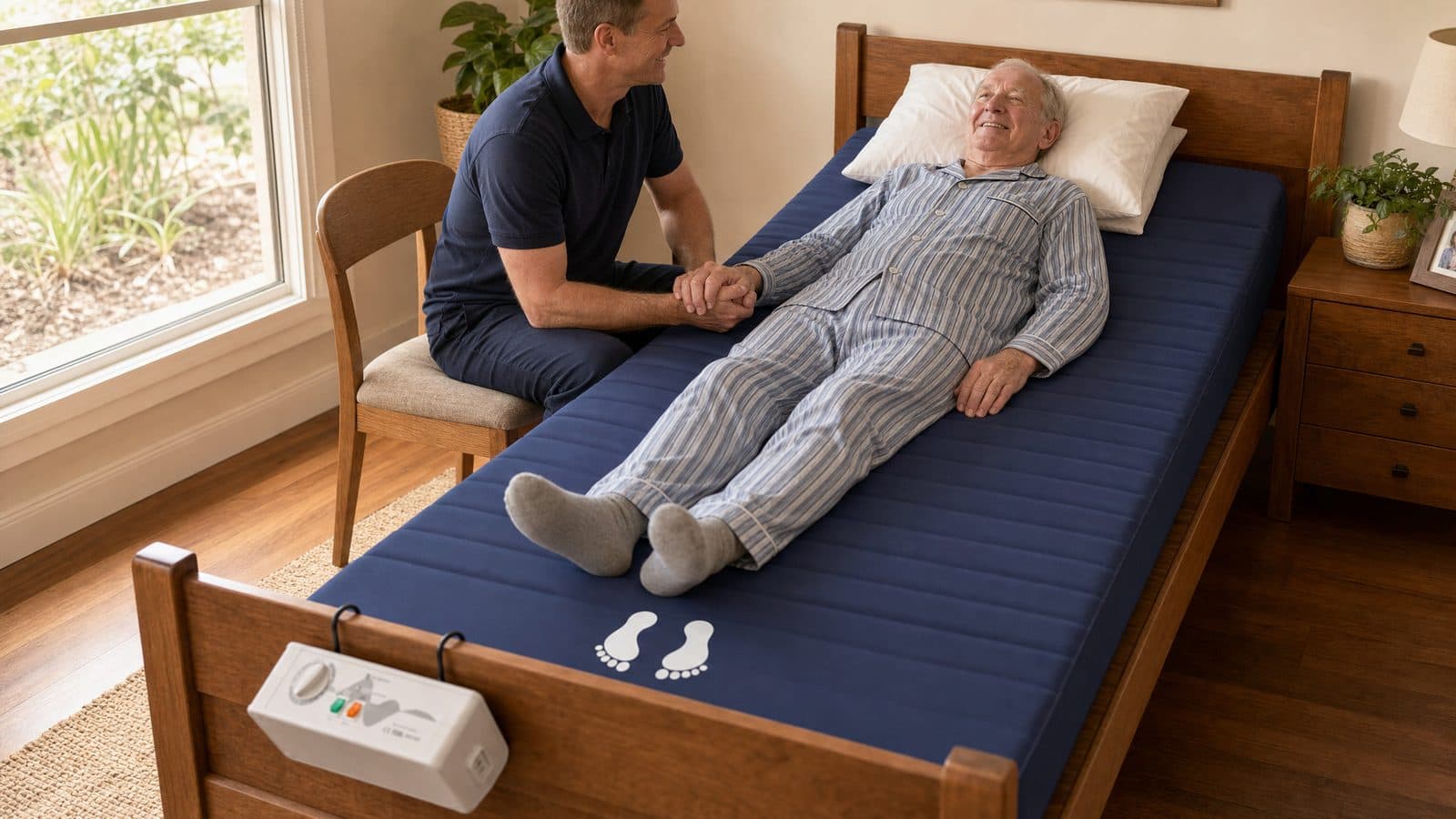
For a side sleeper with a sore neck, the pillow matters more than the bed. The gap between your head and the mattress is the width of your shoulder, and if the pillow does not fill it your neck bends sideways for eight hours. An adjustable bed changes the surface you lie on, which can help — but fixing the pillow first is free, and it is where most of the problem usually is.
This guide covers the pillow, what the bed does and does not change, and how to judge a bed if you decide you want one.
Start with the pillow
Side sleepers need more pillow height than back sleepers, and most people use too little. Lie on your side and have someone look at you from behind: your nose, chin and breastbone should line up, and your head should be level rather than tipped towards the mattress or propped up away from it.
If your head drops, the pillow is too thin. If your neck kinks upward, it is too thick. Broad shoulders need more; narrow shoulders need less. There is no universally correct pillow because there is no universal shoulder.
Two other things side sleepers commonly get wrong:
- The arm under the pillow. Tucking the lower arm under pushes the shoulder forward and up and changes the gap the pillow has to fill. Bringing the arm out in front instead, and letting the pillow do the work, is a free change that some people find fixes it.
- The pillow position. It should fill the space under your neck as well as your head, not just sit under the skull. A gap under the neck means the muscles hold your head up all night.
What the bed changes — and what it doesn't
An adjustable bed changes the shape of the surface you lie on. Raising the head section slightly changes the angle of your upper body, and some side sleepers find that more comfortable than flat. Others find it worse, because raising the head reduces the gap the pillow fills and a pillow that was right is now too tall.
That interaction is the thing to understand: if you change the bed, re-check the pillow. A lot of people raise the head, find their neck worse, and blame the bed for what is now a pillow mismatch.
What we will not tell you is that an adjustable bed treats neck pain. It is a comfort and positioning product. If your neck hurts, and particularly if the pain runs into your arm, wakes you, or is getting worse, that is a conversation for your GP or physiotherapist rather than a furniture purchase.
The mattress does more than the base
For a side sleeper, most of what determines comfort is the surface rather than the angle.
A side sleeper needs a mattress that lets the shoulder sink in while still supporting the waist. Too firm and your shoulder is compressed and your neck compensates; too soft and your midsection drops and your spine bends sideways. No amount of base adjustment fixes the wrong firmness.
Every Sophie adjustable bed includes a four-layer Australian-made mattress topped with the RMIT-tested Hygroflex® comfort layer. Independent testing by RMIT University's School of Engineering found Hygroflex conforms to the body up to 67% better than traditional memory foam and takes less than half the force to roll over. Those are maximums from controlled testing against traditional memory foam rather than a promise about a particular body — but conformity and ease of rolling over are the two properties a side sleeper notices most, because side sleepers change sides through the night.
How to judge a bed
- Does a matched mattress come with it? A base sold on its own leaves you solving the harder half of the problem. And a traditional inner-spring will not work — a single bend can permanently ruin one.
- Can you adjust in small increments? Side sleepers generally want a slight change rather than a dramatic one. Fine control beats a few large presets.
- How easily can you roll over? Test it by actually rolling, not by lying still. A surface that resists it wakes you every time you change sides.
- What happens on a shared mattress? Your partner's adjustments move your side too. A split configuration removes that entirely.
- Can you lie on it for more than a minute? A neck problem shows up after twenty minutes, not two. This is the single reason a showroom is a poor test.
What to do next
Try the pillow first, because it is free and it is usually where the problem is. Give a change a week before judging it.
If the surface is the issue rather than the pillow, we bring the bed to your home and set it up. The demonstration is free and obligation-free and you spend 30 to 60 minutes on it, which for a neck problem matters more than usual — the thing you are judging only becomes apparent with time on the surface.
Call 1300 9 SLEEP (1300 975 337) Monday to Friday, 9am–5pm AEST, or see the Sophie adjustable bed range and our guide for side sleepers with hip discomfort.
Common questions
What pillow height should a side sleeper use?
Enough to fill the gap between your head and the mattress, which is the width of your shoulder. Lie on your side and have someone check from behind: your nose, chin and breastbone should line up and your head should be level. If your head drops the pillow is too thin; if your neck kinks upward it is too thick. Broad shoulders need more.
Will an adjustable bed fix my neck pain?
We will not claim that. It is a comfort and positioning product rather than a treatment. Some side sleepers find a slight head raise more comfortable; others find it worse, because raising the head reduces the gap the pillow fills. If your neck hurts — particularly if the pain runs into your arm, wakes you, or is worsening — that is a conversation for your GP or physiotherapist. This is general information, not medical advice.
Why did my neck get worse after I raised the bed?
Most likely the pillow. Raising the head section reduces the gap the pillow has to fill, so a pillow that was right on a flat bed becomes too tall and pushes your head forward. If you change the bed, re-check the pillow before concluding the bed is the problem.
Does the mattress or the base matter more for a side sleeper?
The mattress. A side sleeper needs a surface that lets the shoulder sink in while still supporting the waist. Too firm and the shoulder is compressed and the neck compensates; too soft and the midsection drops. No amount of base adjustment fixes the wrong firmness.
Can I use my existing mattress on an adjustable base?
Not if it is a traditional inner-spring — a single bend can permanently ruin one. Budget for a compatible mattress as part of the purchase. Every Sophie adjustable bed includes a four-layer Australian-made mattress matched to the base.
Information on this page is general in nature and is not a replacement for professional medical advice. Talk to your GP, occupational therapist or treating clinician about what suits your situation.
This article is general information, not medical advice. For guidance on your situation, talk to your GP or occupational therapist.
Wondering if an adjustable bed would suit your situation?
Our sleep experts talk with Australians in similar situations every day. No pressure, no jargon — just honest answers about what may help you rest more comfortably.
1300 975 337 (1300 9 SLEEP) · Australian-based team · Explore the Sophie adjustable bed range
Rated 4.8 from 227 reviews on ProductReview.com.au · Free in-home demonstration · Interest-free options via Humm, Brighte & Payright for approved purchasers
Using NDIS or Support at Home funding?
Sleep Sophie is a registered NDIS provider (4050070896), and Sophie adjustable beds and lift recliners are ARTG-registered Class 1 medical devices (ARTG 326115). Beds can be funded through NDIS assistive-technology budgets where an occupational therapist recommends them; the Support at Home program has its own equipment pathway. We prepare quotes suitable for plan approval — see how NDIS funding works or Support at Home, or call and we’ll walk you through it.