
Adjustable Beds for Side Sleepers with Hip Pain
10 May 2026 · Nathan Kerrins · Updated 24 September 2026
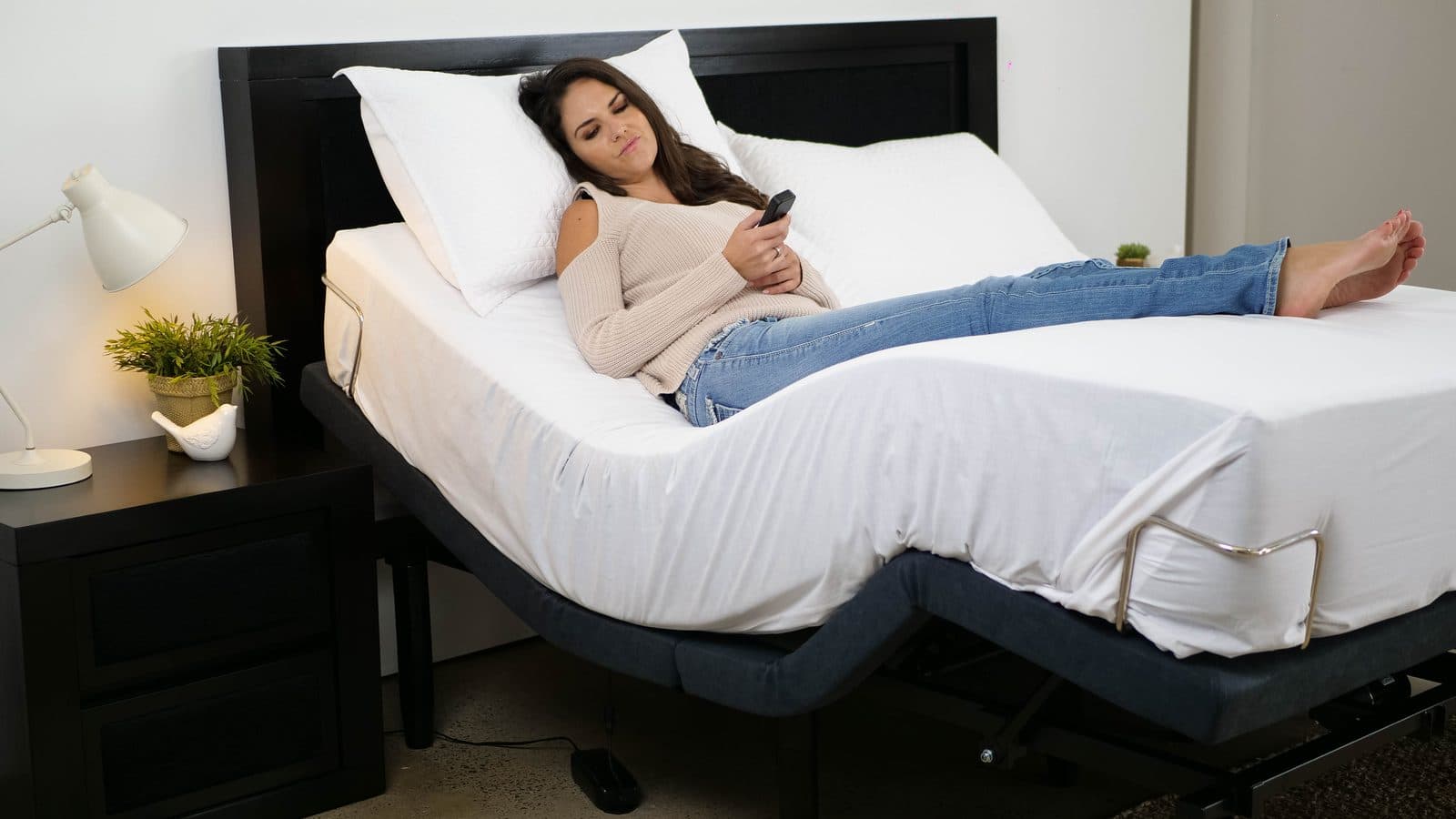
Hip pain can ruin a night’s sleep. If you lie on your side, the pressure on your hips spikes and you wake up sore. An adjustable bed can tilt the head and foot to take the strain off those joints. Adjustable beds for side sleepers offer tailored positioning that can further alleviate hip discomfort, plus a quick checklist to pick the right one for you.
What changing position actually does — and what it doesn't
Side sleeping concentrates your body weight onto a small area: the shoulder and the hip. That is a fact about geometry rather than a medical claim, and it is why side sleepers feel pressure at those two points more than back or front sleepers do.
An adjustable bed changes the shape of the surface you lie on. Some side sleepers find a slight head raise and a slight leg raise more comfortable than flat, because it takes the body out of a straight line and changes where the weight sits. Others find flat suits them better. Both are normal.
What we are not going to tell you is that an adjustable bed treats hip pain. It is a comfort and positioning product. If your hip hurts at night, that is a conversation for your GP or physiotherapist, and a retailer who tells you a bed fixes it should be asked to put that in writing.
For a side sleeper, the mattress matters more than the base
This is the part that gets lost when a bed is sold on its motors.
A side sleeper needs a surface that lets the shoulder and hip sink in while still supporting the waist. Too firm and your weight rests on two points; too soft and your midsection drops and your spine bends sideways. That is a mattress property, not a base property, and no amount of adjustment compensates for the wrong one.
Every Sophie adjustable bed includes a four-layer Australian-made mattress topped with the RMIT-tested Hygroflex® comfort layer. Independent testing by RMIT University's School of Engineering found Hygroflex conforms to the body up to 67% better than traditional memory foam, reduces pressure on the body up to 32% better, and takes less than half the force to roll over. Those are maximums from controlled testing against traditional memory foam, not a promise about any particular body — but conformity and roll-over resistance are exactly the two properties a side sleeper is affected by.
The pillow is half the problem
Side sleepers need more pillow height than back sleepers, and most people use too little. The gap between your head and the mattress is the width of your shoulder, and if the pillow does not fill it your head drops towards the mattress and your neck bends sideways all night.
On an adjustable bed there is a wrinkle worth knowing: raising the head section reduces the gap the pillow needs to fill. A pillow that was right on a flat bed can become too tall once the head is raised, and people often blame the bed for a problem that is now a pillow problem. If you change the bed, re-check the pillow.
The shoulder itself is worth a thought too. Many side sleepers sleep with the lower arm tucked under the pillow, which pushes the shoulder forward and up. Bringing the arm out in front instead, with the pillow filling the gap, is a free change that some people find makes more difference than anything they bought.
Zero gravity, on your side
Zero gravity is a preset that raises both the head and the knees so your body sits in a gentle V. It is usually described and photographed with someone on their back, which leads people to assume it is not for side sleepers.
In practice plenty of side sleepers use it, though usually at a shallower setting than the preset gives. The knee raise is the part that tends to help, because it stops the top leg dragging the hip forward and rotating the pelvis — which is the thing a lot of side sleepers manage by wedging a pillow between their knees.
It is worth experimenting with a small leg raise and no head raise at all, which is not a preset on most beds but is two button presses. That combination suits more side sleepers than the full zero-gravity position does.
Sharing a bed as a side sleeper
Two things come up repeatedly and they have different answers.
Motion. Side sleepers change sides through the night, and on a single shared mattress every one of those movements travels across. A split configuration removes that entirely: two independent bases, two remotes, no transfer. If one of you is a light sleeper this matters more than any other decision on this page.
Disagreement about position. One person wants the head raised, the other wants flat. On a single base that is a negotiation; on a split it is not a question at all. A Split Queen is 2 x 77cm, a Split King is 2 x 92cm, and each side moves on its own.
The honest caveat is that a split costs more than the single-base equivalent and needs the room width to match. Working that out before you buy is considerably cheaper than working it out afterwards.
How to judge a bed if you sleep on your side
- Does the mattress come with it, matched to the base? A base sold without a compatible mattress leaves you solving the harder half of the problem on your own. And a traditional inner-spring will not work — a single bend can permanently ruin one.
- How easily can you roll over? Side sleepers change sides through the night. A surface that resists that wakes you up doing it. This is worth testing by actually rolling, not by lying still.
- Can you adjust in small increments? Side sleepers usually want a slight change rather than a dramatic one. A base with fine control is more useful here than one with a few big presets.
- What happens on a shared mattress? If your partner adjusts their position, you feel it. On a split configuration each side is an independent base with its own remote and nothing carries across.
- Can you lie on it properly before deciding? Two minutes on a showroom floor tells you nothing about a side-sleeping surface. Thirty minutes in your own bedroom tells you most of it.
What to do next
If hip discomfort at night is new, getting worse, or waking you, start with your GP rather than with a bed. If it is a long-standing thing you are managing and you want a more comfortable surface to manage it on, that is a reasonable reason to look at a bed.
We bring the bed to your home and set it up, free and obligation-free, and you spend 30 to 60 minutes on it. For a side sleeper that matters more than usual, because the thing you are judging is how a surface feels under a shoulder and a hip over time, which is not something a showroom can show you.
Call 1300 9 SLEEP (1300 975 337) Monday to Friday, 9am–5pm AEST, or see the Sophie adjustable bed range.
Common questions
Are adjustable beds good for side sleepers?
Many side sleepers find a slight head and leg raise more comfortable than flat, because it takes the body out of a straight line and changes where the weight sits. Others prefer flat. Both are normal, and it is worth trying rather than assuming. The bigger factor for a side sleeper is the mattress, not the base.
Will an adjustable bed help my hip pain?
We are not going to claim that. An adjustable bed is a comfort and positioning product, not a treatment. Some people find a different surface shape more comfortable, which is worth having, but if your hip hurts at night that is a conversation for your GP or physiotherapist. This is general information, not medical advice.
What mattress firmness suits a side sleeper?
One that lets the shoulder and hip sink in while still supporting the waist. Too firm and your weight rests on two points; too soft and your midsection drops and your spine bends sideways. That is a mattress property rather than a base property, and adjusting the base does not compensate for getting it wrong.
Can I use my existing mattress with an adjustable base?
Not if it is a traditional inner-spring. A single bend can permanently ruin one — the interconnected spring system is built to hold a flat plane. Budget for a compatible mattress as part of the purchase. Every Sophie adjustable bed includes a four-layer Australian-made mattress built for the base.
Will my partner feel it when I change position?
On a single shared mattress, yes. On a split configuration — Split Queen, Split King or Split Cali King — each side is an independent base with its own remote, so nothing carries across. For side sleepers who change sides through the night, that is worth considering at purchase rather than afterwards.
Information on this page is general in nature and is not a replacement for professional medical advice. Talk to your GP, occupational therapist or treating clinician about what suits your situation.
This article is general information, not medical advice. For guidance on your situation, talk to your GP or occupational therapist.
Wondering if an adjustable bed would suit your situation?
Our sleep experts talk with Australians in similar situations every day. No pressure, no jargon — just honest answers about what may help you rest more comfortably.
1300 975 337 (1300 9 SLEEP) · Australian-based team · Explore the Sophie adjustable bed range
Rated 4.8 from 227 reviews on ProductReview.com.au · Free in-home demonstration · Interest-free options via Humm, Brighte & Payright for approved purchasers