
Adjustable Bed for Side Sleepers with Back Pain: How to Choose
9 May 2026 · Nathan Kerrins · Updated 1 September 2026
If you sleep on your side and your back is sore in the morning, you have probably worked out by now that the internet is full of lists telling you which bed to buy. Most of them are ranked. Almost none of them explain what the ranking is based on.
This page does something less exciting and more useful. It explains what an adjustable bed physically does, what it can’t do, why a side sleeper’s comfort is mostly decided by the mattress rather than the base, and what to actually check before you spend several thousand dollars. Sleep Sophie makes and sells adjustable beds, so we have an obvious interest in you buying one. That’s exactly why we’d rather give you the criteria than a scoreboard.
What an adjustable bed does for a side sleeper — and what it doesn’t
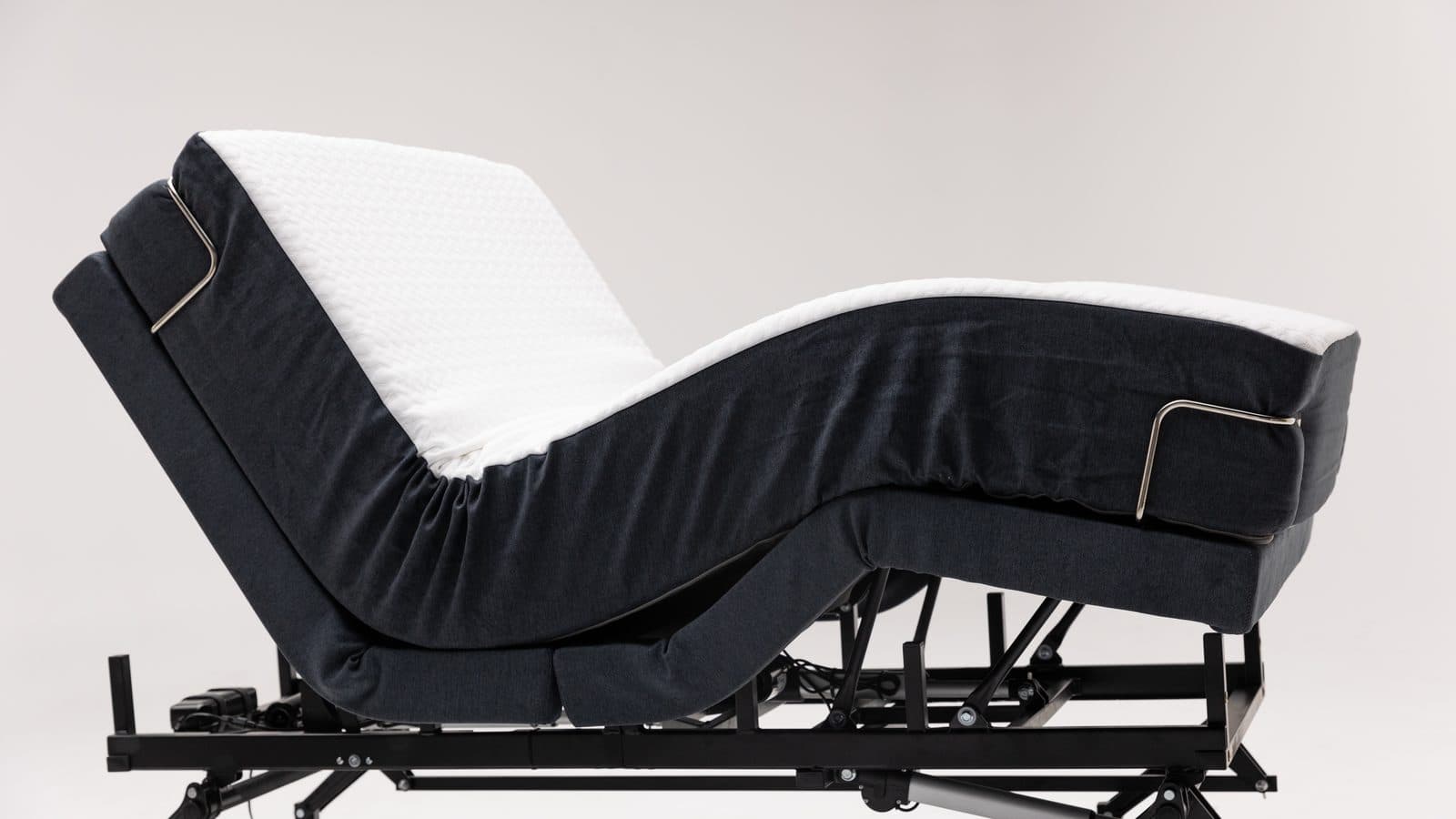
Strip the marketing away and an adjustable bed does four things:
- It raises the head section, so your upper body is propped rather than flat.
- It raises the leg section, so your knees bend and your feet sit higher than your hips.
- It holds that shape all night. Pillows slide. A motorised section doesn’t.
- It changes position on a remote, so you can shift without sitting up, twisting or standing.
Every preset you will ever see advertised — zero gravity, contour, TV, reading, anti-snore — is some combination of those first two movements with a name attached. There is no fifth secret function, and no base on the Australian market has one.
Here is the part the listicles skip. When you lie on your side, you are still lying on your side. Raising the head section changes the shape of the surface under you; it does not change the fact that your shoulder and your hip are carrying most of your weight into the mattress. That is why two side sleepers can buy the same base and reach opposite conclusions. One finds a small head raise settles them; the other finds it pushes the shoulder into an angle they can’t stay in.
An adjustable bed is not a treatment for back pain, and nobody at Sleep Sophie is going to tell you otherwise. If your back pain is new, changing, or waking you most nights, that is a conversation with your GP or physiotherapist before it is a furniture purchase.
Start with the mattress, not the base
Buyers almost always shop for the base first. For a side sleeper it is the wrong order, and it is also where the expensive mistake lives.
A traditional inner-spring mattress can be permanently ruined by a single bend. Not by years of use — by one. The springs and the connecting wires are built to sit flat, and once they have been forced into a curve they can stay that way, leaving a mattress that never lies properly flat again. If a salesperson tells you your existing inner-spring will be “fine” on an adjustable base, that is the claim to push back on, in writing.
What does bend: foam, latex, and hybrids specifically built for adjustable bases.
| Mattress type | Bends with the base? | What side sleepers tend to notice | What to check |
|---|---|---|---|
| Foam | Yes | Shoulder and hip sink in rather than being pushed up; quiet, with no springs to distort | Some foams hold heat — ask what the top layer is designed to do |
| Latex | Yes | Firmer feel with quicker bounce-back; sturdier at the edge when you sit to get up | Heavier to handle; firmness varies enormously between products |
| Hybrid (pocket springs plus foam) | Usually — check the specific model | Spring feel with some foam contouring near the surface | Only pocket-spring designs made for adjustable bases; never a traditional inner-spring |
| Traditional inner-spring | No | — | A single bend can permanently damage it |
For a side sleeper the question underneath all of this is simple: how far does your shoulder sink in before the surface stops it? Too firm and the shoulder is held up, so you roll off it. Too soft and you sink until you can’t roll at all. There is no correct answer and no number anyone can give you from a web page — it depends on your weight, your build, and how you lie.
Every Sophie adjustable bed comes with a four-layer Australian-made mattress, topped with Hygroflex® — a comfort foam that combines memory-foam contouring with latex-style bounce-back. RMIT University’s School of Engineering tested Hygroflex independently against four traditional memory foams. It conforms to the body up to 67% better than traditional memory foam, dissipates heat up to 27% faster, and takes less than half the force to roll over or change position.
That last figure is the one to pause on if you are a side sleeper. It measures the foam’s friction, not anything about your body — but less force to roll over is less force to roll over, and rolling is what side sleepers do all night.
Positions, and why zero gravity is a back-lying position
There is no correct angle, and any page that gives you one to the degree is guessing. What follows is a description of the shapes and how to arrive at your own version of them.
Upper body raised
The head section lifts your torso off the flat. Some people use a small lift and barely notice it; others sleep close to sitting up. On your side, a raised head section changes where your shoulder sits relative to your ear, which usually means your pillow needs to be lower than the one you use flat. Most people don’t expect that and blame the bed.
Legs raised
The leg section bends at the knee and brings your feet up. If you have ever put your feet on the arm of the lounge at the end of a long day, that is the shape. Raising the legs is also the standard positioning advice for puffy ankles and feet — you can lift your legs above your heart to help ease swelling, and a bed holds that position for as long as you want it rather than for as long as the cushions stay put.
Zero gravity
Zero gravity raises the upper back and the knees at the same time, so you are supported in a shallow V rather than lying flat. Sleeping in the zero-gravity position can help to alleviate lower back discomfort — it supports the body with the knees and upper back slightly raised rather than lying flat.
Be clear-eyed about what that means for you, though: zero gravity is a position you lie in on your back. Plenty of side sleepers use it to settle at the start of the night, then roll onto their side once they are comfortable. Others use it for an hour of reading and sleep flat. Both are normal, and neither makes the bed a failure. If you are buying purely for zero gravity, test it lying the way you actually sleep before you commit.
Finding your own settings
Move in small increments and stop at the first position that feels settled — most people overshoot. Give each shape a few minutes before judging it; the first ten seconds of any new position feel odd. When you find one you like, save it as a preset so you can get back to it one-handed in the dark. Two or three saved positions is usually plenty: one for settling at night, one for sitting up, one for getting out of bed.
How to choose a base: the criteria that actually matter
Every brand’s brochure lists the same features. What separates a base you use for a decade from one you regret is a short list, and most of it is unglamorous.
| What to check | Why it matters to a side sleeper | What to ask the supplier |
|---|---|---|
| Split base or single | A split base is two independent beds under one bedhead, so each person sets their own head and leg positions. If your partner sleeps flat and you don’t, this is the whole decision | “Is this one base or two? Do I get two remotes, or one that controls both sides?” |
| Mattress compatibility | The base bends; the mattress has to bend with it, and how far your shoulder sinks decides your comfort | “Is this mattress built for an adjustable base, and will you put that in writing?” |
| Weight rating | The rating covers the whole bed — you, the mattress, anyone else on it, and anything you keep on it | “What is the rating in kilograms, per bed?” Ask for the number, not a reassurance |
| Motor quality and noise | A motor loud enough to wake someone is a motor you stop using after dark, which defeats the point of a bed that moves | “Can I hear it run, at full travel, before I buy?” |
| Bed height | Getting in and out is the thing people notice most after a few weeks, and it is set once, at installation | “What is the height range from the floor, and who sets it?” |
| Warranty | Motors, electronics and the frame are the expensive parts. A long warranty on the timber and a short one on the motor is not a long warranty | “What is covered, for how long, and does someone come to me?” |
| Service and installation | A bed is heavy, awkward and electrical. Who carries it in and who comes back matters more than any preset | “Do your own people deliver and install it, or is it couriered flat-packed?” |
| Funding | If you are an NDIS participant or on a Support at Home package, the paperwork pathway differs by supplier | “Have you supplied through this funding pathway before, and what do you need from my OT?” |
The convenience features are worth a paragraph, because they get sold as luxuries and used as necessities. Saved presets beat holding a button and guessing. Under-bed lighting means getting up at night without turning the main light on. A battery backup brings the bed down if the power drops while it is raised. USB ports keep the phone and a light within reach. App control is genuinely useful to some people and irrelevant to others — decide which you are before you pay for it.
What Sleep Sophie makes, and what it costs
Rather than rank ourselves against anyone, here is the plain description.
The Sophie adjustable bed is a six-leg base that raises the head and leg sections independently, with a height that adjusts between 47.5cm and 65cm from the floor and is set at installation. It is rated to 320kg per bed. It has under-bed lighting, a battery backup, USB ports, a vibration massage function, and app control. It comes with the four-layer Australian-made mattress described above. Split configurations are available in Split Queen, Split King and Split Cali King, which are two separate beds sitting side by side.
The Sophie HiLo adjustable bed does the same head and leg movement, and also raises and lowers the whole bed. It is rated to 250kg and has under-bed lighting and battery backup, but no app control. It is the one to look at if getting in and out — or a carer’s working height — is the real problem rather than the shape you lie in.
Both carry a 5-year comprehensive warranty as standard, extendable to 10 years. Both are delivered and installed anywhere in Australia by our own team, free, including setting the bed height. Sophie beds and recliners are ARTG-registered (ARTG 326115) for their massage function.
On price: across the Australian market, queen and king adjustable beds generally run somewhere between $5,000 and $24,000 while singles run between $3,000 and $13,000. That is a wide band because it covers everything from a basic frame to a fully specified bed with a mattress included. We don’t publish our prices in blog posts, because prices change and a stale figure here would mislead you — the current pricing sits on the adjustable beds page, and interest-free payment options are available through Humm, Brighte and Payright to approved purchasers.
Funding: NDIS and Support at Home
An adjustable bed may be funded as assistive technology where it meets your goals and your plan allows for it. The pathway normally runs through an occupational therapist’s recommendation and your plan manager or planner, and it takes longer than people expect — start the conversation early.
Sleep Sophie is a registered NDIS provider (provider number 4050070896). The scheme funds supports against your plan rather than endorsing particular products, and no supplier can promise your funding will come through. Our NDIS page and Support at Home page explain how each process works.
Try it in your own bedroom
Five minutes lying on a bed with your shoes on, in a showroom, under fluorescent light, tells you very little — and it tells a side sleeper almost nothing, because nobody rolls onto their side in front of a salesperson.
Sleep Sophie will bring the bed to your home, set it up, demonstrate it, and leave you to spend 30 to 60 minutes with it while we are there. It is free and obligation-free. Lie the way you actually sleep. Roll over. Get out of bed and get back in. Bring your own pillow. If you share the bed, have your partner there too, because their opinion arrives eventually either way.
To arrange one, book a free in-home demonstration or call 1300 9 SLEEP.
What to ask your GP or physiotherapist
This is the part of the decision a bed retailer cannot help with, and it is the part worth getting right. Questions worth taking with you:
- Are there positions I should avoid, given what is going on with my back?
- Is there anything about how I currently get in and out of bed you would change?
- Would raising my legs be sensible in my situation, and is there a limit on how far?
- What bed height would suit me for standing up and sitting down safely?
- Is a bed the right piece of equipment at all, or is something else a better first step?
That last question is the one people skip. Sometimes the answer is a rail, a different pillow, or a change to a routine — all considerably cheaper than a bed.
FAQ
Is an adjustable bed good for side sleepers with back pain?
An adjustable bed doesn’t treat back pain and we won’t claim it does. What it does is raise the head section, raise the leg section, hold that shape all night, and let you change it with a remote. For a side sleeper, how comfortable those shapes feel depends mostly on the mattress and pillow you use with them. Whether the positions suit your situation is a question for your GP or physiotherapist.
What angle should a side sleeper set the head section to?
There is no correct number, which is why we don’t publish one. Move in small increments, give each position a few minutes before judging it, and stop at the first shape you can settle into. Expect to need a lower pillow than you use on a flat bed once the head section is raised.
Can I use my existing mattress on an adjustable base?
Only if it bends. Foam, latex and hybrids built for adjustable bases are fine. A traditional inner-spring is not — a single bend can permanently damage the springs so the mattress never lies properly flat again. Check before you move it onto a base, not after.
Do I need a split base if I share the bed?
You need one if you and your partner want different positions. A split configuration is two independent beds side by side under one bedhead, each with its own motors and its own remote, so one person sitting up to read doesn’t move the other. If you both sleep flat and always have, a single base is fine and cheaper.
What weight rating should I look for?
Ask for the specific number rather than a reassurance. Sophie adjustable beds are rated to 320kg per bed and Sophie HiLo adjustable beds to 250kg. The rating covers the bed as a whole, so factor in the mattress, everyone using it, and anything you keep on it.
Does motor noise really matter?
It matters if you change position at night or share a room. A motor loud enough to wake someone is a motor you end up not using after dark. Listen to it run through its full travel in person rather than trusting the word “whisper-quiet” in a brochure.
Can I get an adjustable bed through the NDIS?
It may be funded as assistive technology where it meets your goals and your plan allows for it, usually on an occupational therapist’s recommendation. Sleep Sophie is a registered NDIS provider (provider number 4050070896). Funding is never guaranteed, and the scheme funds supports against your plan rather than endorsing particular products — so start with your OT and planner.
Conclusion
An adjustable bed raises your head, raises your legs, holds the shape, and hands you the controls. That is the entire product, whoever makes it. For a side sleeper the more important decisions sit on top of the base — the mattress that decides how far your shoulder sinks, and the pillow that has to change height once the head section lifts.
So work through the criteria rather than the rankings. Confirm the mattress bends. Get the weight rating in kilograms. Hear the motor. Read what the warranty actually covers. Then lie on the thing, on your side, in your own bedroom, with your own pillow.
If you want to do that, book a free in-home demonstration. If you are still sorting fact from sales pitch, our adjustable bed myths page works through the claims you will hear while you shop, and our guides to mattresses for side sleepers and adjustable beds for side sleepers go deeper on fit.
Information on this page is general in nature and is not a replacement for professional medical advice. Talk to your GP, occupational therapist or treating clinician about what suits your situation.
This article is general information, not medical advice. For guidance on your situation, talk to your GP or occupational therapist.
Wondering if an adjustable bed would suit your situation?
Our sleep experts talk with Australians in similar situations every day. No pressure, no jargon — just honest answers about what may help you rest more comfortably.
1300 975 337 (1300 9 SLEEP) · Australian-based team · Explore the Sophie adjustable bed range
Rated 4.8 from 227 reviews on ProductReview.com.au · Free in-home demonstration · Interest-free options via Humm, Brighte & Payright for approved purchasers