
Adjustable Bed for Leg Cramps Australia: What a Bed Can and Can’t Do
24 March 2026 · Nathan Kerrins · Updated 1 September 2026
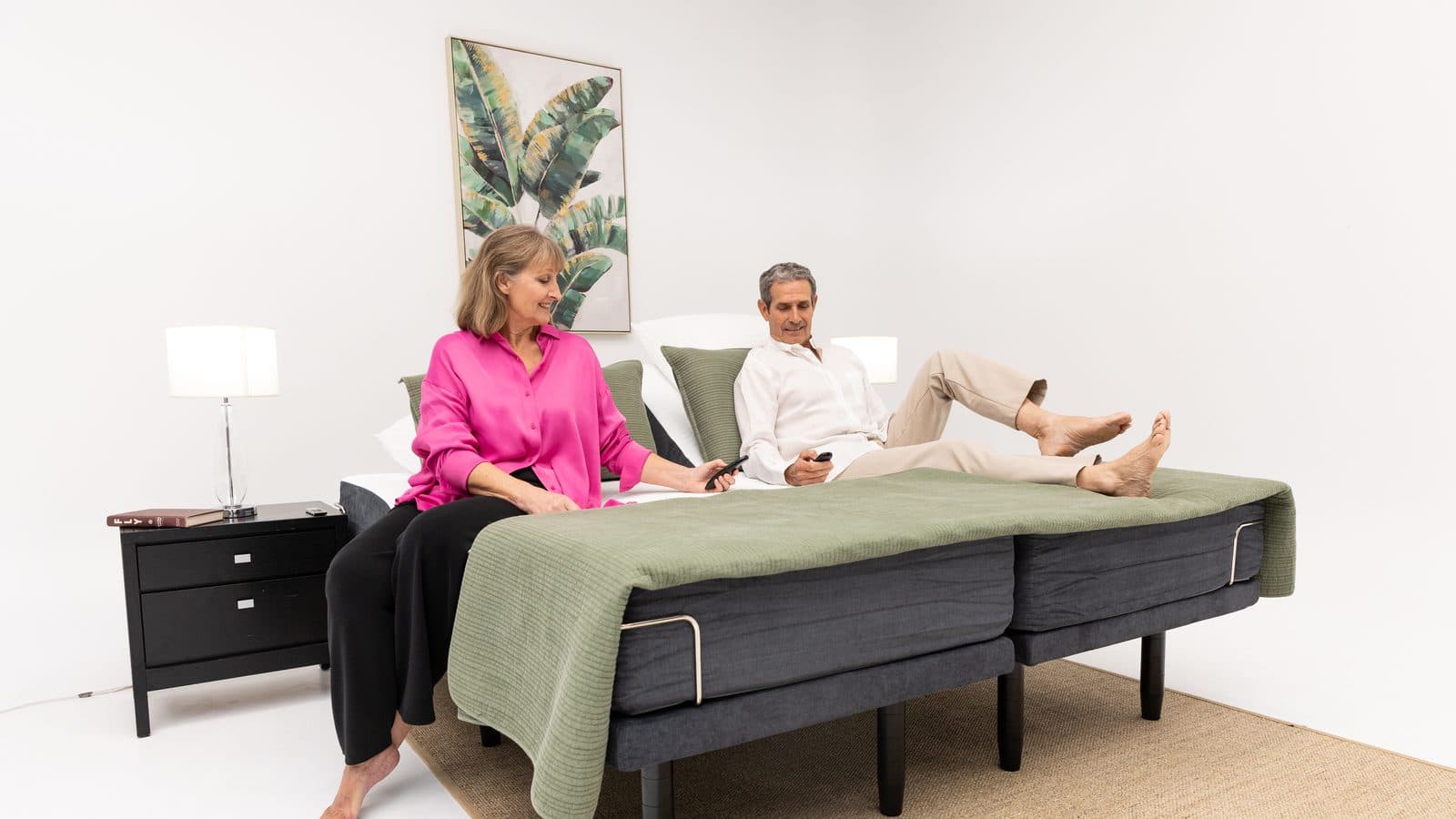
A cramp at 2am is a particular kind of awful. You’re asleep, then you’re not, then you’re standing on a cold floor with your calf locked solid, waiting it out.
If that’s happening regularly, the first stop is your GP or pharmacist. Night cramps have causes worth investigating — medications, hydration, and other things a bed shop has no business guessing at. We’re not going to pretend a mattress is the answer to that.
What we can tell you honestly is what an adjustable bed does. It raises your head section, raises your leg section, holds those positions all night, and lets you change them with a remote instead of getting out of bed. This page covers the positions people find comfortable, how to set them up, what to look for in the mattress and base, and what to take to your doctor.
What an adjustable bed can and can’t do
Let’s deal with the honest answer first, because you’ll find plenty of pages online that won’t give you one.
An adjustable bed is not a treatment for leg cramps. It doesn’t act on your muscles, and nobody should be selling you one on that basis. If a retailer tells you their bed stops cramps, ask them to put it in writing.
What an adjustable bed actually gives you is two things: positions and control.
- Positions. The head and leg sections move independently, so you can be propped, or have your knees bent and your feet higher than your hips, or both — and the bed holds that shape rather than letting it collapse the way a pillow stack does.
- Control. When something wakes you, you can change position with one hand from where you’re lying. For anyone who currently has to swing their legs out and stand up in the dark, that’s the part that tends to matter.
Step 1: Positions with your legs raised
The leg section is the part of the bed most people on this page care about, so here’s what it actually does and what people use it for.
Legs raised
The leg section bends at the knee and brings your feet up, so your lower legs are supported along their length rather than resting flat. It’s the shape you make when you put your feet up on the arm of the lounge after a long day — the difference is that the bed holds it, so you keep it while you sleep instead of losing it the moment you shift.
Raising the legs is also the standard positioning advice for puffy ankles and feet. You can lift your legs above your heart to help ease swelling, and an adjustable bed lets you set that position and leave it set. If swelling is what’s bothering you, that’s worth raising with your clinician too — it can have causes worth checking.
Zero gravity
Zero gravity is a preset that raises the upper back and the knees at the same time, so you’re held in a shallow V rather than lying flat. It’s the position most people ask to try, and reactions to it are genuinely split — some settle into it immediately, others don’t like it at all. It’s a good argument for testing before you buy rather than reading about it.
Upper body raised
Worth mentioning even on a page about legs, because it’s the position you’ll use most in the evening. The head section props your torso for reading or watching something, and plenty of people simply prefer to fall asleep with a slight lift rather than flat.
Here’s a walkthrough of the zero-gravity position on a Sophie adjustable bed, so you can see what the sections do.
Step 2: Setting the angles and saving them
You’ll see pages that tell you the exact number of degrees to use. Ignore them — those numbers are made up, and bodies aren’t standard. Here’s a more useful approach.
Move in small increments. Hold the button briefly, stop, and wait. Give each position at least a couple of minutes before you decide, because the first ten seconds in any new shape feel strange even when the shape is right. Most people overshoot on their first go and end up further raised than they actually want.
Then save what you land on. This is the underrated feature of the whole product: a saved preset means one button in the dark, one-handed, without sitting up or hunting for a light. If you’re someone who currently gets out of bed to sort yourself out at night, a preset is the difference between a small adjustment and a full wake-up.
One more practical note: fitted sheets on an adjustable bed need to be deep enough to stay put when the sections bend, and a doona sits differently when your knees are raised. Neither is a problem, but both are worth sorting out in the first week rather than blaming the bed.
Step 3: The mattress has to bend
This is the part people get wrong, and it’s an expensive mistake.
A traditional inner-spring mattress can be permanently ruined by a single bend. Not by months of use — by one. The springs and the wires linking them are built to lie flat, and once they’ve been forced into a curve they can stay bent, leaving you with a mattress that never sits properly flat again. If anyone tells you your existing inner-spring will be fine on an adjustable base, that’s the claim to push back on before you move it.
Foam, latex and hybrids designed for adjustable bases are the ones that bend and recover. Ask specifically whether the mattress is built for an adjustable base — “it’s foam” isn’t the same answer.
Every Sophie adjustable bed includes a four-layer Australian-made mattress topped with Hygroflex®, a comfort foam that combines memory-foam contouring with latex-style bounce-back. RMIT University’s School of Engineering tested Hygroflex independently against four traditional memory foams. It conforms to the body up to 67% better than traditional memory foam, dissipates heat up to 27% faster, and takes less than half the force to roll over or change position.
That last one is the figure to notice on a page about broken sleep. Less force to change position is less effort every time something wakes you.
Step 4: What to check before you buy
Features get sold as luxuries. The ones people actually use at 3am are far less glamorous than the brochures suggest.
| What to check | Why it matters at night | What to ask |
|---|---|---|
| Motor noise | A loud motor is one you won’t use after dark, which defeats the point | “Can I hear it run, in a quiet room?” |
| Saved presets | One button beats holding a button and guessing in the dark | “How many positions can I save, and how do I set them?” |
| Under-bed lighting | Getting up without turning the main light on | “Is it fitted to this model?” |
| Battery backup | If the power drops while the bed is raised, you can still lower it | “What happens in a blackout?” |
| Independent sides | One of you can have legs raised while the other stays flat | “Is a split base available in my size?” |
| Bed height | Getting your feet to the floor safely, first go | “Is the height adjustable, and is it set at installation?” |
| Weight rating | Covers everyone and everything on the bed, not just one person | “What’s the rating for this exact model, in kilograms?” |
For the record on the Sophie range: under-bed lighting is fitted to the adjustable bed and the HiLo bed, battery backup to both plus the Embrace recliner, and USB ports to every bed. App control is on the Sophie Adjustable Bed only, not the HiLo. The six-leg base adjusts between 47.5cm and 65cm from the floor, set at installation. Sophie adjustable beds are rated to 320kg per bed; Sophie HiLo adjustable beds are rated to 250kg.
On massage: Sophie beds include a vibration massage function, and some people like a few minutes of it before they settle in. Treat it as a comfort feature you’ll either enjoy or ignore — try it at a demonstration and make your own call rather than paying for it on a promise.
You can see the full range and specifications on the Sophie adjustable beds page.
Step 5: Looking after the bed
An adjustable bed is a piece of machinery in your bedroom, and it lasts longer if you treat it like one. None of this is difficult.
- Keep the underneath clear. The sections need room to move, and stored boxes under a bed are the most common cause of a jammed frame.
- Check the cable. Make sure the power lead and remote cable can’t be pinched as the sections move — worth a look whenever you move the bed to vacuum.
- Vacuum the vents and hinges. Dust builds up around the motors like it does behind a fridge.
- Rotate the mattress. Follow the mattress instructions for how and how often.
- Unplug it before any deep clean. Simple, and it protects both you and the electronics.
- Follow the manual for lubrication and servicing. Don’t improvise with whatever spray is in the shed — the wrong product attracts dust and can gum up the mechanism.
Sophie adjustable beds and HiLo beds carry a 5-year comprehensive warranty as standard, extendable to 10 years. Keep the paperwork somewhere you’ll find it, and check what any supplier’s warranty actually covers — motors, electronics and frame are the parts that cost money. Full detail is on our warranties page.
What to ask your GP or pharmacist about night cramps
This is the part of the problem a bed retailer genuinely can’t help with, and it’s the part most worth your time. Some questions to take with you:
- Could any of my current medications be contributing?
- Is there anything worth testing or ruling out, given how often this happens?
- Is there anything you’d suggest I do in the evening, or at the moment a cramp starts?
- Are there positions I should avoid, or a limit on how far I should raise my legs?
- I’ve noticed swelling as well as cramps — is that worth looking at separately?
- Would you refer me to anyone else about this?
If getting in and out of bed safely is part of the picture, an occupational therapist can assess that specifically — including whether a bed is the right piece of equipment at all, or whether a rail or a change of height would do the job for far less money.
FAQ
Will an adjustable bed stop my leg cramps?
No, and we won’t claim otherwise. An adjustable bed changes the position you lie in and lets you change it again with a remote — it doesn’t act on your muscles. Night cramps have causes worth investigating, so take them to your GP or pharmacist rather than to a bed retailer.
Can I use a standard inner-spring mattress with an adjustable base?
No. A traditional inner-spring mattress can be permanently damaged by a single bend — the springs and connecting wires are made to lie flat, and once bent they may not return. Use foam, latex or a hybrid built for an adjustable base, and check before you move the mattress onto the base.
How high should I raise the leg section?
There’s no correct number, which is why we don’t publish one. Move in small increments, give each position a couple of minutes before judging it, and stop at the first shape that feels settled. If you have a condition or an injury, ask your clinician whether there’s a limit on how far you should raise your legs.
What is the zero-gravity position?
It’s a preset that raises your upper back and your knees at the same time, holding you in a shallow V rather than flat. It’s the position most people want to try, and opinions on it are genuinely divided — which is why it’s worth testing on a real bed rather than deciding from a description.
Does the massage function help with cramps?
We can’t tell you that it does. Sophie beds include a vibration massage function and some people enjoy a few minutes of it before settling in, but treat it as a comfort feature rather than a reason to buy. Try it at a demonstration and decide whether you’d actually use it.
Can I share an adjustable bed with a partner who doesn’t need the positions?
Yes. A split base gives each side its own head and leg positions, so one of you can have your legs raised while the other stays flat. On a single base, save your position as a preset and agree on a shared setting — plenty of couples manage fine that way.
How do I look after an adjustable bed?
Keep the space under and around the bed clear so the sections can move, check the power lead and remote cable can’t be pinched, vacuum dust from the motor vents and hinges, rotate the mattress as its instructions say, and unplug the bed before any deep clean. Follow the manual for lubrication rather than improvising.
Conclusion
An adjustable bed raises your head, raises your legs, holds the shape, and puts the controls in your hand. That’s the product. It won’t fix why your calf seizes up at 2am, and any page that tells you otherwise is selling you something.
What it can do is make the night easier to manage — a position you can settle into, a light you don’t have to stand up for, and a button that changes things without waking you fully. Whether that’s worth it is a decision best made lying on one.
If you’d like to test the positions in your own bedroom, we’ll bring a bed to you, set it up and let you spend 30 to 60 minutes with it — free, obligation-free, and in the room it would actually live in. Book a free in-home demonstration or call 1300 9 SLEEP.
Information on this page is general in nature and is not a replacement for professional medical advice. Talk to your GP, occupational therapist or treating clinician about what suits your situation.
This article is general information, not medical advice. For guidance on your situation, talk to your GP or occupational therapist.
Wondering if an adjustable bed would suit your situation?
Our sleep experts talk with Australians in similar situations every day. No pressure, no jargon — just honest answers about what may help you rest more comfortably.
1300 975 337 (1300 9 SLEEP) · Australian-based team · Explore the Sophie adjustable bed range
Rated 4.8 from 227 reviews on ProductReview.com.au · Free in-home demonstration · Interest-free options via Humm, Brighte & Payright for approved purchasers