
Here’s a surprise: only 17% of adjustable beds actually come with built-in lift assist. That’s the one feature that can make the biggest difference when a senior needs help getting in and out of bed. And most people have no idea it’s even an option.
If you’re trying to figure out how to choose an adjustable bed for seniors with limited mobility, you’re in the right place. This guide breaks down the five most important things to look for. We’ll cover mattress compatibility, frame safety, remote controls, room size, and warranty. By the end, you’ll know exactly what questions to ask and which features actually matter. Let’s get started.
1. Assess Mattress Compatibility and Type
Not every mattress works with an adjustable base. In fact, using the wrong one can damage the mattress or make the bed less comfortable. So when you’re learning how to choose an adjustable bed for seniors with limited mobility, start with the mattress.
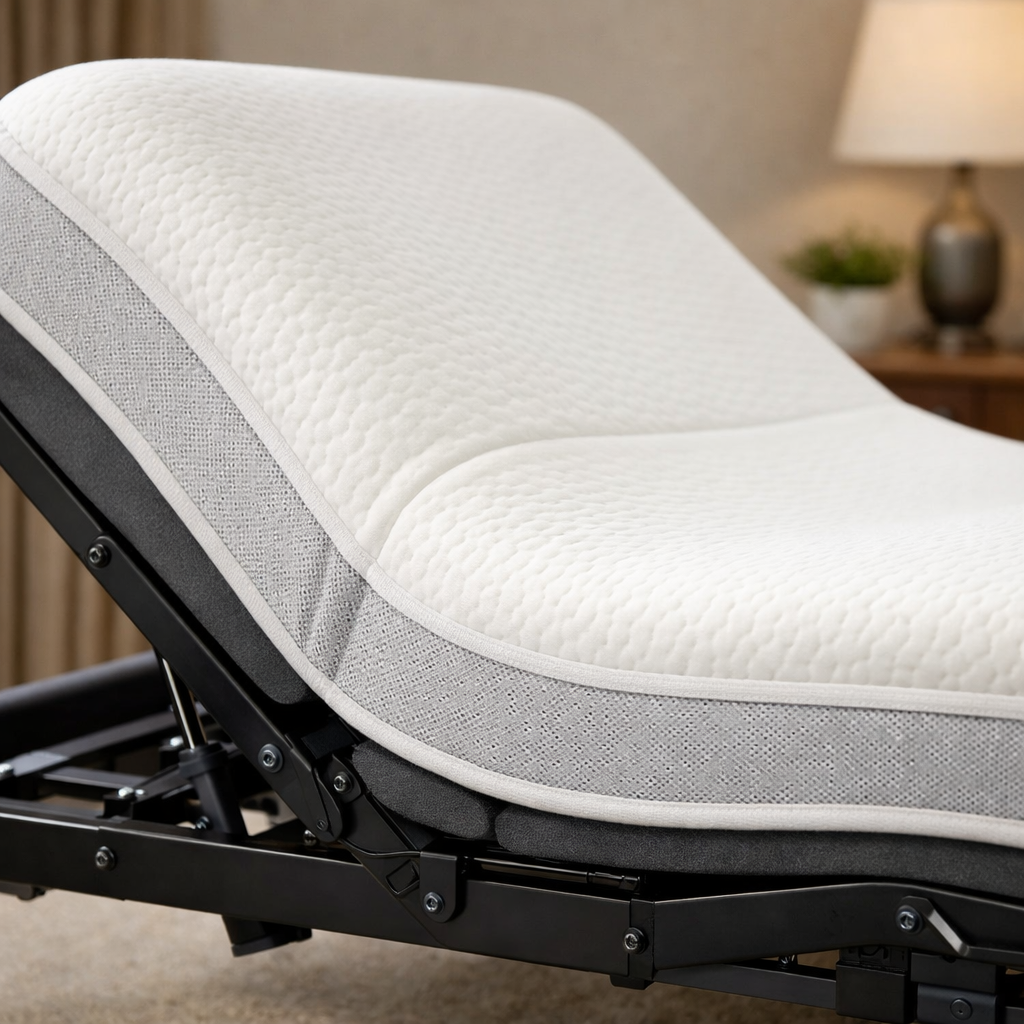
Memory foam is the gold standard. It bends easily and stays put when the head or foot of the bed moves. Hybrid mattresses can work too, but only if the coils are individually wrapped and flexible. Traditional innerspring mattresses are usually too stiff and can break the frame.
According to the National Council on Aging (NCOA), the Nectar Memory Foam mattress is the best overall for adjustable beds. It scored high for pressure relief and edge support, and testers found it easy to change positions without feeling stuck. The NCOA also emphasizes that a medium-firm feel helps reduce back and joint pain, which is critical for seniors with limited mobility.
When testing a mattress for an adjustable bed, pay attention to thickness. Mattresses over 13 inches thick can be heavy and may not flex well. Also check that the mattress has a retainer bar or a non-slip bottom to stop it from sliding when the bed is angled. Some adjustable bases come with a mattress retainer bar built in, but cheaper models might not include one.
Another thing to consider: if you’re buying a new mattress with the adjustable base, look for one that offers at least a 100-night trial. That way you can test the setup and return it if it doesn’t feel right. Several brands, including Sleep Sophie, bundle the mattress and base together, saving you the hassle of matching sizes.
Don’t forget about temperature regulation. Memory foam can get hot, so look for cooling gel layers or breathable covers. This matters because seniors often have circulation issues that make them more sensitive to heat.
Bottom line: Stick with memory foam or flexible hybrid mattresses, avoid thick or stiff models, and always confirm the mattress is adjustable-bed compatible before purchase.
For more detailed guidance, check out Sleep Sophie’s 6 Things Seniors should consider before purchasing an Adjustable Bed. It covers budgeting, mattress types, and positioning.
2. Evaluate Frame Construction and Safety Features
Safety is the biggest concern when you learn how to choose an adjustable bed for seniors with limited mobility. A sturdy frame prevents falls and keeps the bed stable during adjustments. But not all frames are built the same.
First, look for built-in lift assist. Research shows only 17% of adjustable beds include this feature, yet it’s a game-changer for seniors with limited mobility. Brands like ComfortSleep Electric and SleepWell Electric from sleepsophie.com.au list it explicitly. Lift assist uses a motor to gently raise the head and foot, making it easier to sit up or get out of bed.
Weight capacity is another hidden spec. Only 20% of models disclose it. That’s risky because if the bed is undersized, it can sag and become unstable. The highest capacities reach 850 lb, while the lowest is around 385 lb. When you’re evaluating how to choose an adjustable bed for seniors with limited mobility, always ask for the weight limit. Look for a bed that supports at least 250 kg (550 lb) for a single user.
| Feature | What to Look For | Why It Matters |
|---|---|---|
| Built-in Lift Assist | Yes, clearly listed in specs | Helps seniors sit up and stand with less effort |
| Weight Capacity | ≥250 kg (550 lb) | Prevents sagging and ensures stability |
| Motor Noise Level | ≤30 dB (whisper-quiet) | Doesn’t disturb sleep partner |
| Side Rails | Folding, lockable, padded | Prevents falls during sleep |
| Mattress Retainer Bar | Included at foot of bed | Stops mattress from sliding when head is raised |
Motor noise matters too. Our research found that most adjustable beds hover around 30 decibels, which is quieter than a refrigerator. One outlier reached 47 dB, which is noticeably louder. For seniors with sensitive hearing or partners who are light sleepers, a quiet motor is essential.
Side rails are another safety must-have. Models like those from MedShopDirect offer folding side rails that lock into place. Test the rail by pushing it firmly , if it wobbles, it’s not safe. Padded rails prevent bruising if you bump against them.
Also check for under-bed lighting. Motion-activated lights help seniors handle to the bathroom at night without turning on bright lights that can cause disorientation.
“A bed with built-in lift assist and decent weight capacity can turn a struggle into a smooth, safe transition.”
Bottom line: Prioritize lift assist, high weight capacity, quiet motors, and sturdy side rails to ensure the bed is safe for daily use.
For a deeper dive on safety, see Sleep Sophie’s adjustable bed safety tips for seniors.
3. Consider Remote Control and Ease of Use
If the remote is hard to use, the bed is hard to use. That’s why when you’re figuring out how to choose an adjustable bed for seniors with limited mobility, the controls matter a lot.
According to our research, 48% of adjustable beds come with wireless remotes. That’s good because it means no tangled cords. But not all wireless remotes are equal. Look for one with large, backlit buttons. Seniors with arthritis or poor vision need clear labels they can read in dim light. Pocket-sized wireless remotes appeared in two beds, suggesting a trend toward ergonomic designs that fit easily in a hand.
Some models also offer app control or voice commands. This can be a lifesaver for seniors who struggle with fine motor skills. For example, the Saatva Adjustable Base Plus offers a wireless remote with a built-in flashlight and optional app control, as reviewed by the NCOA. But app control requires a smartphone and reliable Wi-Fi, so it might not be the best choice for everyone.
Another important feature is memory presets. Most adjustable beds allow you to save two to three positions, like zero gravity, anti-snore, or a custom reading angle. With one button, the bed moves to that exact position. That’s much easier than trying to find the perfect angle by pressing up and down repeatedly.
Test the remote before buying. Ask if the store has a demo model you can try. Press the buttons while lying down. Is the layout intuitive? Can you reach the flat button quickly if you feel uncomfortable? If you have to squint or guess, keep looking.
Also check for USB ports. Many beds now include them on both sides, so seniors can charge phones or tablets without getting up. Integrated massage functions are another bonus, but make sure the controls for those are separate from the main position buttons to avoid confusion.
Here’s a quick video showing how a wireless remote works on a popular adjustable bed:
Bottom line: Choose a bed with a wireless, backlit remote that has large buttons and memory presets to make daily adjustments easy.
For more on remote features, check out Skyward Medical’s guide on adjustable beds for seniors, which covers voice control and hi-low adjustments.
4. Look at Size and Room Configuration
Size matters more than you think. When you’re learning how to choose an adjustable bed for seniors with limited mobility, the bedroom dimensions can make or break the experience. A bed that’s too big will make the room feel cramped and hard to handle with a walker or wheelchair.
Adjustable beds come in all standard sizes: Twin (38″ x 75″), Twin XL (38″ x 80″), Full (54″ x 75″), Queen (60″ x 80″), King (76″ x 80″), and Split King (two Twin XL bases side by side). For seniors sleeping alone in a smaller room, a Twin or Twin XL is often enough. For couples, a Split King allows each person to adjust their side independently , a big plus if one partner has limited mobility and the other doesn’t.
Before you buy, measure your bedroom. Leave at least 30 inches of clearance on both sides and the foot of the bed for walking space. Remember that adjustable beds can raise the head up to 65 degrees, which means the bed will sit higher off the ground in some positions. If you have low windowsills or shelves, make sure the bed won’t hit them when fully improved.
The Turmerry website notes that a Queen bed fits well in a 10×10 foot room, while a King needs at least 12×12 feet. If your room is smaller, consider a Full or Twin XL. Also factor in the height of the base itself. Many adjustable beds have legs that adjust from 6 to 18 inches. Lower heights make it easier for seniors to get in and out of bed, especially if they use a transfer aid.
Another consideration: split beds. Split King and Split Queen bases consist of two separate frames. This allows each sleeper to choose their own positions without disturbing the other. But split bases also mean two remote controls and two power cords. Make sure you have enough outlets and that the nightstand can hold both remotes.
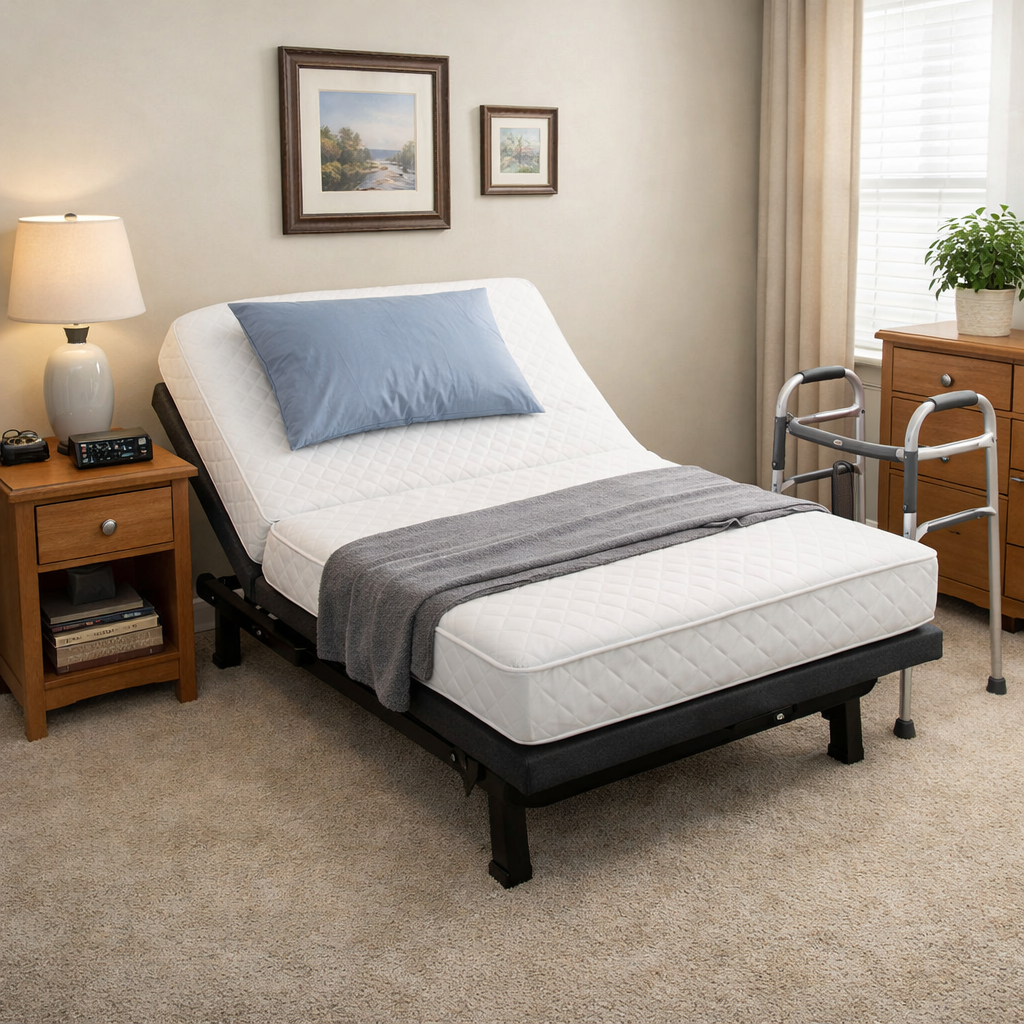
Bottom line: Measure your room first, then choose a bed size that leaves at least 30 inches of walkway on all sides, and consider split options for couples.
For more on sizing, read Sleep Sophie’s guide on Adjustable Bed for Seniors with Limited Space Australia.
5. Review Warranty and Return Policies
An adjustable bed is a big purchase. You want to know it’s protected. That’s why when you’re deciding how to choose an adjustable bed for seniors with limited mobility, the fine print matters.
Most adjustable beds come with a limited warranty that covers the frame and mechanical parts for up to 25 years and the electrical components for 3 to 5 years. For example, the Saatva Adjustable Base Plus offers a 25-year limited warranty on the frame and a 5-year limited warranty on the electrical parts, as mentioned by Sleep Foundation. Nectar provides a 3-year warranty on the adjustable base, and Brooklyn Bedding offers a 5-year warranty. But not all warranties are equal. Some are prorated, meaning you pay more of the repair cost as time goes on. Look for a warranty that is fully non-prorated for at least the first 5 years.
Return policies also vary widely. Nectar gives you a 50-night sleep trial with free returns. Saatva’s Adjustable Base Plus is made to order and cannot be returned or exchanged , only the mattress can be returned. That’s a huge difference. If you’re unsure, choose a brand with a generous trial period. Puffy offers 101 nights, and Nectar offers 60 nights.
Also ask about white-glove delivery. This service includes delivery, setup, and removal of your old bed. For seniors with limited mobility, it’s worth the extra cost. Saatva includes free white-glove delivery; Nectar charges $199. Without it, you’ll need to assemble the bed yourself, which can be difficult for someone with physical limitations.
Don’t forget to check what’s excluded from the warranty. Many policies don’t cover damage from improper use, like using a non-compatible mattress. Some require you to register the product within 30 days. Read the fine print carefully, or ask a customer service rep to email you a copy before buying.
Bottom line: Look for a non-prorated warranty of at least 5 years on electrical parts and a 50-night trial with free returns and white-glove delivery.
For a complete list of warranty details, refer to the Sleep Foundation’s guide to adjustable beds for seniors, which breaks down policies from major brands.
Conclusion
Choosing the right adjustable bed for a senior with limited mobility doesn’t have to be overwhelming. Focus on five key areas: mattress compatibility, frame safety, remote ease of use, room size, and warranty. Start by checking if the mattress will bend without damage. Look for built-in lift assist and a high weight capacity , these two specs are often missing but critical. Pick a wireless remote with large backlit buttons and memory presets. Measure your bedroom carefully and choose a size that leaves plenty of walkway. And never skip the fine print: a good warranty and trial period protect your investment.
Here in Australia, Sleep Sophie offers a range of adjustable beds designed with seniors in mind. Their models include built-in lift assist, quiet motors, and adjustable legs to fit your room. They also provide white-glove delivery and a solid warranty. If you want to see exactly what fits your needs, visit their website or give them a call. A comfortable, safe, and easy-to-use bed can make a world of difference for the senior in your life.
Remember, the goal is not just a bed that moves , it’s a bed that helps the user move better. So keep that in mind as you weigh your options, and don’t hesitate to ask questions. The time you spend learning how to choose an adjustable bed for seniors with limited mobility will pay off in better sleep and greater independence.
Frequently Asked Questions
Can I use my existing mattress with an adjustable bed?
Not all mattresses work with adjustable bases. Memory foam and thin hybrid mattresses under 13 inches thick are usually compatible. Traditional innerspring and thick pillow-top mattresses are often too stiff. Test your mattress by bending the head end; if it resists, it may damage the frame or lose support over time. Some brands, like Sleep Sophie, sell complete mattress-and-base bundles that guarantee compatibility. Always check with the manufacturer before using an existing mattress.
What weight limit should I look for in an adjustable bed for seniors?
Weight capacity is rarely advertised , only 20% of models disclose it. For a single senior, a minimum of 250 kg (550 lb) is recommended to ensure stability and prevent sagging. The highest capacities reach 850 lb (e.g., Saatva Adjustable Base Plus). If the user weighs more than 150 kg (330 lb), look for a bariatric model with reinforced steel and a wider frame. Don’t assume the bed can handle the weight; ask for the spec in writing.
Does Medicare cover adjustable beds for seniors?
Medicare Part B may cover an adjustable bed if it is prescribed as durable medical equipment (DME) for a specific medical condition, such as severe arthritis or a recent surgery. However, coverage is limited to certain types of electric beds, not all adjustable bases. You’ll need a doctor’s prescription and a supplier that accepts Medicare. In Australia, NDIS participants may also qualify for funding through approved providers like Sleep Sophie. Check with your health fund or local program for details.
What is the best mattress type for an adjustable bed?
Memory foam is the best choice because it conforms to the base’s movements without cracking. Gel-infused memory foam adds cooling. Latex is also flexible but heavier and more expensive. Hybrid mattresses with individually wrapped coils can work if the coils are encased in foam and the mattress is not too thick (under 13 inches). Avoid traditional innerspring mattresses with continuous coils , they don’t bend properly and can break the frame. Always check the manufacturer’s recommendation.
How quiet should the motor be?
Most adjustable bed motors operate at around 30 dB, which is quieter than a normal conversation (60 dB) and similar to a refrigerator hum. Some budget models hit 47 dB, which may disturb a partner. Look for “whisper-quiet” or “silent motor” in the product description. Decibel ratings are rarely listed, but you can find real-world feedback in video reviews. At Sleep Sophie, our motors are tested to ensure they stay below 35 dB. If you’re sensitive to noise, ask for a demo or check online reviews.
Can I use my existing headboard and footboard?
Yes, most adjustable bases can be attached to existing bed frames using universal brackets. However, you need to make sure there’s enough clearance for the moving parts. The base may require 2-4 inches of space at the head and foot. If your headboard is tall and solid, it might interfere with the bed when raised. Measure carefully and check the manufacturer’s instructions. Some brands, like Sleep Sophie, design their bases to fit into most standard bed frames.
What is the difference between a split king and a regular king adjustable bed?
A split king uses two Twin XL adjustable bases side by side, each with its own remote. This allows each sleeper to adjust their side independently , one can improve the head while the other stays flat. A regular king uses a single large base with one remote. Split king is ideal for couples with different mobility needs or sleep positions. The downsides are two power cords and two remotes, and a small gap between the mattresses. Bedding like fitted sheets must be split king compatible.
How long does it take to receive and set up an adjustable bed?
Delivery times vary by brand. Many online retailers ship within 2-7 business days. White-glove delivery, which includes setup and removal of your old bed, typically adds 1-2 weeks to the schedule. Without it, you’ll need to assemble the base yourself, which usually takes 30-60 minutes. Tools are often included. If the senior lives alone or has limited mobility, white-glove delivery is strongly recommended to avoid strain and ensure proper installation.