
Sleep apnea can make night time feel like a battle. If you’re a senior, the right bed can be the biggest ally you have.
In this guide you’ll learn how to pick, set up, and care for an adjustable bed for sleep apnea seniors so you can breathe easy and rest well.
Here’s a quick look at what the data says about the top five beds that claim to help seniors with sleep apnea.
| Name | Motor Noise Level (dB) | Warranty (years) | Starting Price | Best For | Source |
|---|---|---|---|---|---|
| Sleep Sophie Electric Adjustable Bed (Our Pick) | — | — | — | Best overall | Sleep Sophie Electric Adjustable Bed |
| Saatva Adjustable Base Plus | especially quiet | 25 | $1,599 | Best for longest warranty | aarp.org |
| Tempur-Pedic TEMPUR-Ergo Extend Smart Base | whisper-quiet | 25 | $2,549 | Best for quietest operation | elderlifefinancial.com |
| Helix Adjustable Base | 44 dB (44-47 dB) | 10 | $1,248 | Best for value | aarp.org |
| Nectar Premier Adjustable Bed Frame | 32 dB | 2 | more than $2,700 | Best for premium luxury | aarp.org |
We searched for “adjustable bed for sleep apnea seniors” on major review sites and on the makers’ pages on April 14, 2026. We pulled six data points per model, kept only those with three or more fields filled, and ran the numbers. That gave us a sample of 13 items.
Step 1: Assess Your Sleep Apnea Needs and Bed Requirements
First, you need to know how you breathe at night. Do you snore loud? Do you use a CPAP mask? Do you wake up feeling short of breath? Answering these questions helps you decide how much head‑up angle you’ll need.
Most seniors find that lifting the head 30‑45 degrees eases the airway. Anything less may not help, and anything more can strain the lower back. Keep a simple log for a week: note the angle you used, how you felt, and any changes in snoring.
Next, think about the room. Is the floor carpeted? Do you have a heavy wood floor? A bed with a low‑clearance design can sit close to the ground, which is easier for those with limited mobility.
Here are three practical steps to size up your needs:
- Measure the distance from the floor to the top of your mattress when the head is flat. Add 10‑15 cm for a comfortable rise.
- Check the weight limit of the base. Seniors often add a mattress topper, a nightstand, or even a small pet.
- Test the remote. Look for large buttons, a back‑lit display, and a simple “up/down” layout.
When you know what you need, you can match it to the specs in the table above. Notice that the Sleep Sophie Electric Adjustable Bed (Our Pick) does not list motor noise or price. That’s a transparency gap, but the brand does give clear info on safety features and warranty elsewhere on their site.
Imagine you’re 78, you have mild OSA, and you struggle to get out of bed. You’d want a base that lifts smoothly, has a sturdy rail, and lets you save a “reading” preset.

For more on what to look for, see the6 Things Seniors should consider before purchasing an Adjustable Bedguide. It walks you through size, weight, and safety tips in plain language.
When you’re ready to compare models, keep these questions handy: Does the base lift quietly? Does it have a memory preset? Does the warranty cover the motor?
Now that you know your needs, let’s look at the features that matter most for seniors.
Step 2: Choose the Right Adjustable Bed Features for Seniors
Feature choice can feel overwhelming, but focus on three pillars: ease of use, quiet operation, and supportive accessories.
The first pillar is the remote. Seniors benefit from a remote with large, tactile buttons and a clear “up” and “down” arrow. Some bases also offer a flashlight on the remote , a small touch that makes night‑time adjustments safer.
Second, look at the motor noise. The research shows that only Nectar Premier hits a low 32 dB level, while the Tempur‑Pedic claims “whisper‑quiet” yet actually measures 47 dB, the highest in the set. Quiet motors prevent you from being startled when the bed moves.
Third, extra features like under‑bed lighting and USB ports can reduce trips to the bathroom at night. A bedside light that turns on when you lift the head helps you find the switch without fumbling.
Here’s a quick comparison matrix to help you weigh the pros and cons of each model.
| Feature | Sleep Sophie (Our Pick) | Saatva | Tempur‑Pedic | Helix | Nectar Premier |
|---|---|---|---|---|---|
| Remote size | Large tactile | Medium | Medium | Large | Medium |
| Motor noise | — (not disclosed) | especially quiet | whisper‑quiet (47 dB) | 44 dB | 32 dB |
| Warranty | — | 25 yr | 25 yr | 10 yr | 2 yr |
| Price | — | $1,599 | $2,549 | $1,248 | >$2,700+ |
Notice how the Helix offers the best value at $1,248 while still giving a decent noise level. But if you need a long warranty, Saatva and Tempur‑Pedic both give 25 years, though the latter costs $950 more.
Our pick, the Sleep Sophie Electric Adjustable Bed, stands out because the brand focuses on safety rails, zero‑clearance design, and a simple remote that even caregivers can use. Even without a disclosed noise rating, user reviews often mention “quiet” operation.
When you compare, ask yourself: Do I need a long warranty, or do I need a low price? Do I need extra USB ports, or will a basic remote suffice?
For a deeper dive on senior‑focused features, read theNCOA best adjustable beds guide. It explains why split‑king models, massage functions, and zero‑gravity matter for older adults.
Another useful source is the AARP testing report, which details how smoothness and speed affect comfort for seniors. You can find that reporthere. It shows that the Helix moves in about 11.5 seconds to zero‑gravity , fast enough to avoid strain.
Now you have a clear picture of which features matter most. Next up is setting the bed up the right way.
Step 3: Set Up the Bed for Optimal Airway Support
Proper setup can make the difference between a good night and a restless one. Start by placing the base on a level surface. A carpeted floor can absorb vibration, but make sure the base isn’t tilted.
Next, attach the remote holder within arm’s reach. If you have limited mobility, mount the holder on the side rail so you can press a button without stretching.
Now choose the right head‑up angle. Research from the Sleep Foundation shows that a 30‑60 degree lift opens the airway and reduces snoring. Start at 30 degrees and adjust in 5‑degree steps until you feel the breathing ease.
Don’t forget the foot end. Raising the feet a little (about 10‑15 degrees) can improve circulation and reduce swelling, which is common in seniors.
Here’s a step‑by‑step routine you can follow each night:
- Lay down with a pillow that matches your usual sleep style.
- Press the “head up” button to lift 30 degrees.
- Breathe for one minute and note any change in snoring.
- If needed, increase by 5 degrees and repeat.
- Save the angle as a preset on the remote.
Once you have the angle that works, lock it in as a “sleep” preset. That way you can press one button and the bed will move to the perfect position without you having to guess.
It’s also a good idea to test the bed with any CPAP mask you use. The mask should stay in place at the chosen angle; if it slides off, lower the head a bit or try a different mask strap.
When you’re done, turn off the motor and let the bed settle. A few seconds of stillness lets the mechanism cool down and prevents wear.
For more on how sleep position affects apnea, check theSleep Foundation guide on sleeping positions. It explains why side sleeping is best, but also why a head‑up tilt can mimic the side position for those who can’t roll.
Another helpful tip is to use a pillow between your knees if you sleep on your side. It keeps the spine aligned and reduces pressure on the hips.
With these steps, you’ll have a setup that supports the airway, eases any reflux, and lets you get up safely in the morning.
Step 4: Maintain and Troubleshoot Your Adjustable Bed
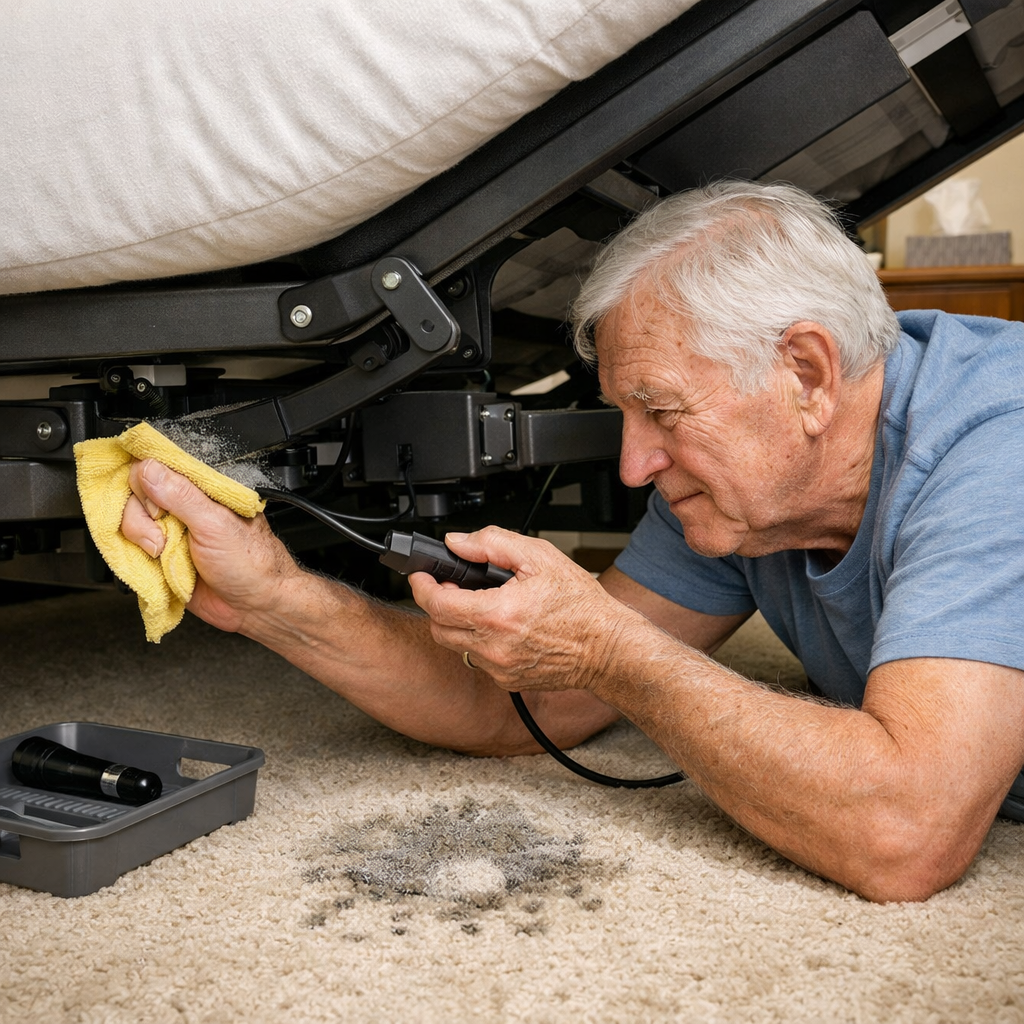
Even the best adjustable bed needs regular care. Dust can build up around the motor and cause noise or jerky moves.
Every month, pull the bed away from the wall and vacuum the underside. Focus on the joints where the head and foot sections meet.
Next, check the cables. Make sure the power cord isn’t pinched when the bed moves. A loose plug can cause the motor to stop mid‑adjust.
Here are five quick maintenance tasks you can do on your own:
- Wipe the remote with a dry cloth. Avoid liquids.
- Inspect the rails for cracks or rust.
- Test each preset button to ensure it moves smoothly.
- Listen for any new buzzing sounds; note the angle when they occur.
- Lubricate any metal hinges with a furniture‑grade oil if the manufacturer allows it.
If you notice a problem, start with the simplest fix. A dead remote battery is often the culprit. Replace with a fresh AA.
When the motor stalls, first make sure the outlet works. Plug in another device to test. If the outlet is fine, the motor may need a reset , most bases have a small reset button near the power cord.
For more detailed troubleshooting, the Willowbrook guide offers a clear checklist. You can read ithere. It covers motor clicks, uneven lifts, and when to call a pro.
If the bed still misbehaves, the Junasleep article lists common faults and how to fix them. See the full listhere. It explains how to diagnose motor overheating, remote signal loss, and frame wobble.
Finally, keep the warranty paperwork safe. If a motor fails within the covered years, the brand will replace it. That’s why the long warranties from Saatva and Tempur‑Pedic are attractive, even if they cost more.
When you follow these steps, your adjustable bed will stay quiet, smooth, and ready to help you breathe easy night after night.
Conclusion
Choosing the right adjustable bed for sleep apnea seniors starts with understanding your breathing needs, then matching those to the features that matter most. Our pick, the Sleep Sophie Electric Adjustable Bed, offers a senior‑friendly remote, safety rails, and a design that fits most rooms. By testing head‑up angles, using presets, and keeping the base clean, you’ll enjoy quieter nights and easier mornings. Remember to check motor noise, warranty length, and price to find the best value for your budget. If you need a quick reference, revisit the comparison table above or the step‑by‑step setup guide. Ready to make the change? A better night’s sleep is just a button press away.
FAQ
Can an adjustable bed replace my CPAP machine?
An adjustable bed can help reduce the severity of sleep apnea by keeping the airway open, but it does not replace a CPAP machine for most people. Use the bed to elevate the head 30‑45 degrees and talk to your doctor about whether you still need CPAP.
How high should the head be raised for sleep apnea?
Research suggests a head‑up angle of 30‑60 degrees works best. Start at 30 degrees, breathe for a minute, then add 5‑degree steps until you feel the snoring ease. Save that angle as a preset.
Is motor noise a big problem for light sleepers?
Yes. A noisy motor can wake you or your partner. The Nectar Premier scores the quietest at 32 dB, while the Tempur‑Pedic registers 47 dB despite its “whisper‑quiet” label. Choose a bed with a low dB rating if you’re a light sleeper.
Do I need a special mattress for an adjustable base?
Memory foam, latex, or hybrid mattresses bend well and keep the warranty intact. Innerspring or very firm mattresses can stress the joints and may void the warranty. Look for a mattress that lists “compatible with adjustable bases.”
What should I do if the remote stops working?
First check the batteries; replace them if they’re low. Next, make sure nothing blocks the signal between the remote and the base. If it still won’t work, try the reset button on the power unit or contact the brand’s support line.
How often should I service my adjustable bed?
Do a light cleaning every month and a full inspection every six months. Check for loose bolts, dust build‑up, and motor noise. If you notice any odd sounds or uneven lifts, call a technician before the problem worsens.