
A restless night can feel like a battle you’ll never win. For seniors with back pain, the fight gets real. A good night’s sleep can change the whole day.
That’s why an adjustable bed for elderly with back pain australia is more than a luxury, it’s a practical aid. By gently lifting the head or feet, pressure on the spine eases and you can find a comfy spot without rolling over. If you want to pick the right model, start with the guide on Choosing the Best Adjustable Bed for Back Pain that walks you through key features.
Try this quick checklist tonight. Set the head at about 30 degrees, it eases lower back strain. Raise the foot slightly to help leg swelling. Keep the remote where you can reach it without stretching. For more tips, see the Semantic Search SEO guide that shows how to find reliable reviews.
When you follow these steps, you’ll notice less tossing and more calm. Better sleep means brighter mornings and a stronger body. Ready to make the change? Your new night’s rest is just a few clicks away.
Step 1: Assess Your Loved One’s Comfort and Health Needs
Start by sitting with the senior and asking how they feel when they get out of bed. Note if the back hurts, if they feel stiff, or if they wake up with a sore neck.
Jot those answers down. A short list helps you see if the pain is worse after sitting long or if it eases when the legs are raised. This tells you which angles to try.
Look at any doctor notes. If a physio says “keep the spine neutral,” you’ll need a bed that lets you fine-tune the head and foot angles in small steps.
Walk around the room. Is the nightstand low? Is the floor carpeted? A remote that’s out of reach turns a helpful bed into a hassle.
For more on what to check, the Adjustable Bed for Elderly Australia guide walks through safety rails, weight limits and quiet motors.
Write a quick “must-have” list: head lift, foot lift, easy remote, sturdy frame. If swelling is an issue, add a foot-raise option.
Try a test night at about 30 degrees head and 10 degrees foot. Adjust a little each night until the back feels supported.
When you have that list, you can talk to the supplier and match the features to your needs, saving time and money.
Caregivers who also handle tech might find this local IT support for small business guide useful for keeping smart bed controllers secure.
Watch the video, then note which features felt most useful for your loved one.

Step 2: Choose the Right Mattress Support for Back Pain
First, think about how your spine sits when you lie down. If the mattress lets your hips sink too far, your back will curve and you’ll wake up sore.
Most seniors find a medium‑firm feel hits the sweet spot. It holds the spine in a neutral line while still giving a little give for comfort. A 2008 study showed medium‑firm beds cut back pain by more than half, and that finding still holds true today.
Look for a mattress that blends support with breathability. Memory foam feels great but can trap heat, which may make you toss and turn. Cooling hybrids or latex layers let you stay cool and keep your spine aligned.
Weight matters, too. If you’re under 68 kg, a softer surface can work. Between 68 kg and 104 kg, stick with medium‑firm. Over 104 kg, you may need a firmer core or extra pocket‑spring support.
Don’t forget the age of your current mattress. After about eight years the foam or springs start to lose bounce, and you’ll feel gaps that pull your spine out of line.
Here’s a quick way to test a new mattress before you buy:
- Lie on your side. Feel if your hips sink more than a finger‑width.
- Switch to your back. Your lower back should feel cradled, not pressed.
- Roll gently. If you bounce back quickly, the support is even.
For more details on why medium‑firm works, check out this guide from Best in Beds.
| Support Feature | Best For | Tip |
|---|---|---|
| Medium‑firm hybrid | Most sleepers 68‑104 kg | Balances pressure relief and spine alignment |
| Cooling latex | Hot sleepers, back pain | Stays cool, offers firm bounce |
| High‑density foam core | Heavier users 104 kg+ | Prevents sagging, keeps spine level |
With the right support in place, your adjustable bed can truly ease back pain each night.
Step 3: Evaluate Adjustable Features and Controls
Set the head angle
First, set the head angle. Tilt it about 30 degrees for lower-back relief; that lifts the spine without pulling the neck. If the head feels too high, drop a few degrees until you feel supported.
Adjust the foot lift
Next, raise the feet. A gentle 10-15 degree lift eases swelling in the legs and reduces pressure on the lower back. Test by sliding a hand under the calves and it should clear easily.
Use built-in presets
Many beds, like the Peace Lily model, include preset modes such as “Zero-Gravity” or “Anti-Snore.” These one-touch settings combine head and foot angles that research shows help spinal decompression.
Check remote placement
Check the remote. It should sit on the nightstand, not across the room. Buttons need to be easy to press, even with arthritic fingers. If the remote feels stiff, consider a bedside holder.
Consider extra functions
Look at extra features. Vibration massage can loosen tight muscles, but turn it off if it makes you feel jittery. Under-bed LED lights are handy for late-night trips, yet they’re optional.
Fine-tune firmness controls
Some models let you adjust the mattress firmness with a button. A softer setting can help a sore back, while a firmer feel supports sitting up. Test both and pick what feels best.
Do a quick comfort test
Do a quick test. Lie in your chosen mode for a few minutes. Your hips should stay level, your back should feel cradled, and you should be able to sit up without strain.
Verify weight capacity
Make sure the bed’s weight capacity matches the user. Most electric bases support up to 150 kg; exceeding it can wear the motor and reduce smooth movement.
Write down your favourite settings. A simple note helps caregivers repeat the perfect position night after night.
Step 4: Prioritise Safety, Accessibility, and Mobility
Safety isn’t an after‑thought, it’s the base of every good night’s sleep.
First, clear the floor around the bed. Aim for at least a one‑metre walking lane so a walker can glide past.
Australian bedroom design guidelines recommend at least 1 000 mm clear space around the bed, as explained by The Painted Hinge.
Add a sturdy rail
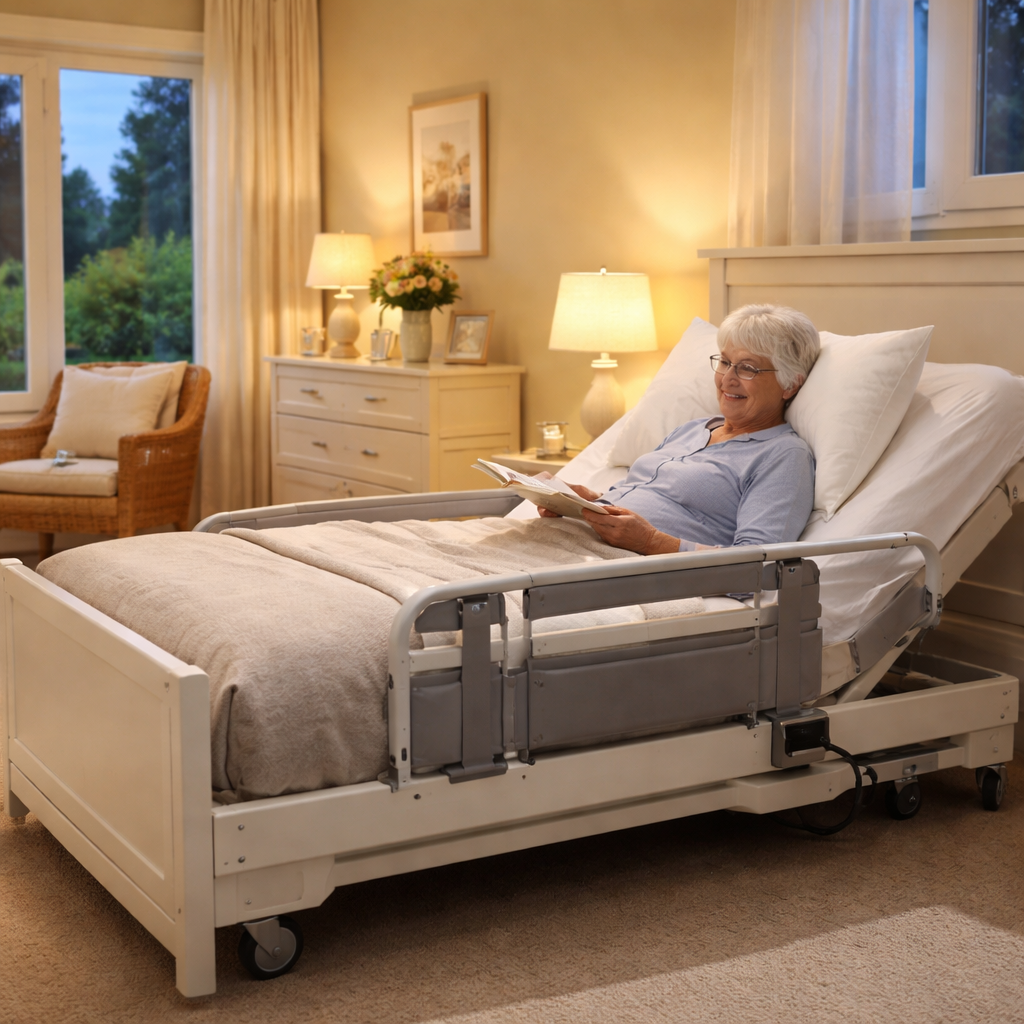
Bed rails give a handhold for sit‑to‑stand moves. Choose models that fit electric bases and support up to 136 kg, like those on Mobility Shop Direct. The slide‑and‑secure design needs no tools.
Place controls within reach
The remote or wall switch should sit no higher than 110 cm and no lower than 60 cm. When the button is at waist height, you won’t have to stretch or bend.
And what about night‑time trips? Install a low‑level amber night‑light that turns on with motion. It lights the path without waking the whole house.
Floor and carpet choices
Non‑slip rugs or low‑pile carpet give grip for bare feet and walkers. Avoid thick rugs that can catch wheels.
A smooth floor helps the motor glide. Choose a surface safe for the user and the mechanism.
Set the right height
Mid‑knee height is a good rule, about the distance from floor to the knee. Most users find 45–55 cm lets them sit up and swing legs over without strain.
Adjust the side you raise most often so the rail lines up with the user’s dominant hand.
Quick safety checklist
1. Clear 1 m lane. 2. Install rail. 3. Remote at 60‑110 cm. 4. Motion night‑light. 5. Non‑slip floor. 6. Bed height mid‑knee.
Follow these steps and you’ll cut the risk of falls while keeping the bed easy to use.
Step 5: Purchase, Setup, and After‑Care Tips
When you’re ready to buy, think of the bed as a tool you’ll use every night. Look for a model that lets you move the head and foot with a simple remote and that fits the size of the room.
Pick the right seller
Sleep Sophie lists a range of adjustable beds for elderly with back pain australia. Choose a seller that offers a clear return policy and a warranty on the motor.
Plan delivery wisely
Ask the seller if they work with a local professional electric bed assembly service. A trained crew can get the bed through tight doors, set the height correctly, and test the controls before they leave.
Having the crew on hand also means they can remove any old bed without you having to lift a heavy frame.
Set it up for safety
- Place the bed on a flat, stable floor. A non‑slip rug works, but it shouldn’t be thick enough to catch wheels.
- Adjust the leg extensions so the mattress sits about mid‑knee height (45‑55 cm). This lets a senior sit up and swing their legs over without strain.
- Mount the remote or wall switch between 60 cm and 110 cm. Test it with arthritic fingers – the buttons should press easily.
- Attach a rail on the side the user leans toward. Make sure the rail can hold at least 136 kg.
After‑care routine
Run a quick check each week. Make sure the motor hums smoothly, the remote batteries are fresh, and the rail bolts stay tight.
Wipe the frame with a soft damp cloth. Avoid harsh chemicals – a mild soap and water mix is enough.
If you hear any strange noises, call the assembly team right away. Early fixes stop bigger problems later.
Finally, keep the user’s comfort diary. Note which head‑foot angles feel best for back pain. Over time you’ll see a pattern and can set the bed to the perfect preset.
Conclusion
Choosing an adjustable bed for elderly with back pain australia isn’t a luxury, it’s a real step toward calmer nights and brighter mornings.
You’ve seen how the right head tilt, foot lift and sturdy rail can ease pressure and keep falls low.
Set it up on a flat floor, keep the remote within arm’s reach, and test the rail with a light pull.
A quick weekly check, motor hum, battery fresh, bolts tight, catches issues before they grow.
If you’re ready to make the change, Sleep Sophie’s range of electric bases offers the comfort and support many seniors need.
Start with a simple trial: set the head at 30°, raise the feet a few inches, and note how you feel after a night’s rest.
You’ll soon notice the difference and sleep will feel like a gentle hug.
Give it a few weeks and let your body adjust.
FAQ
What makes an adjustable bed good for elderly with back pain in Australia?
An adjustable bed lets you lift the head or feet without rolling over. That eases pressure on the spine and helps blood flow. Look for a smooth motor, a remote that sits on a nightstand, and a sturdy rail that can hold the user’s weight. A bed that can tilt about 30° at the head and 10‑15° at the foot works well for most back‑pain sufferers.
How do I choose the right mattress for an adjustable base?
Pick a mattress that stays firm enough to support the spine when the bed moves. Medium‑firm hybrids or latex layers give a solid feel while still being comfortable. Test it by lying flat, then with the head raised – you should feel cradled, not sunk. If the mattress feels too soft, it can cause the hips to drop and the back to curve.
Can I use an adjustable bed if my loved one uses a wheelchair?
Yes, as long as the bed’s height matches the wheelchair seat. Aim for a mid‑knee height (about 45‑55 cm) so the user can swing their legs over easily. Check the weight limit – most electric bases handle up to 150 kg. Add a rail on the side the person leans toward for extra safety when getting in and out.
How often should I check the bed’s safety features?
Do a quick check each week. Listen for a smooth hum from the motor. Make sure the remote batteries are fresh and the rail bolts stay tight. Wipe the frame with a damp cloth and avoid harsh chemicals. If anything sounds squeaky or feels loose, call the assembly team before it gets worse.
Is an adjustable bed covered by the NDIS?
Many NDIS participants can list an adjustable bed under “assistive equipment” if it helps with daily living. You’ll need a therapist’s recommendation that shows the bed reduces back strain or improves sleep. Check the plan’s guidelines and submit the quote with supporting notes. The process can take a few weeks, so plan ahead.
What should I do if the bed stops moving?
First, check the power plug and make sure the outlet works. Then look at the remote – replace the batteries if needed. If the motor still won’t turn, see if any safety lock is engaged. Most brands, including Sleep Sophie, offer a local service team that can diagnose and fix motor issues quickly.